This page contains affiliate links. Please read our disclosure for more info.
TeamLab Planets Tokyo is an interactive digital art museum that uses lights, projections, water, and sounds in creative ways.
It’s an immersive, surprising experience that dissolves the boundaries between the viewer and the art.
Some people say this popular attraction is overrated, but we think it’s unique and magical.
In this TeamLab Planets review, I share what to expect at the museum, practical details like how to get tickets (they do sell out), and our best TeamLab Planets tips (including what to wear to manage the water sections).
I’ve updated this post with the new areas that opened in 2025, making TeamLab Planets even better.
Contents
- TeamLab Planets Location
- TeamLab Planets Hours
- Best Time to Visit TeamLab Planets
- TeamLab Planets Tickets
- How Long to Visit TeamLab Planets
- What to Wear to TeamLab Planets
- What to Expect at TeamLab Planets
- UZU Ramen
- What Are the Best Areas in TeamLab Planets?
- How to Get to TeamLab Planets
- What to Visit Near TeamLab Planets
- TeamLab Planets vs Borderless
- Is TeamLab Planets Worth It?
- More Japan Posts
TeamLab Planets Location
TeamLab Planets is located in Toyosu, a manmade island and neighbourhood of Tokyo. It’s a little out of the way from central Tokyo, but it can be reached by public transport in about 45 minutes from Shinjuku and Shibuya.
See below for how to get there.
You can see the TeamLab Planets location on Google Maps.
TeamLab Planets Hours
TeamLab Planets’ opening hours and closing days vary, so it’s best to check the TeamLab website.
It is usually open from 8.30am – 10pm (with UZU ramen open 11am – 9.30pm).
TeamLab Planets is currently due to close at the end of 2027, but there’s always the chance it will be extended (as it has in the past).
Best Time to Visit TeamLab Planets
The best time to visit TeamLab Planets is at opening on a weekday.
We love being among the first to enter, as it’s much quieter for the first hour.
On our second visit, we had most of the Water area to ourselves by staying ahead of the crowds.
If that’s not possible, I would choose 6pm or 3-4 hours before closing.
Keep in mind that the last orders for Uzu Ramen are 30 minutes before closing, and you can’t eat before entering the museum.
The middle of the day is busiest, so avoid weekends and public holidays if you can.
TeamLab Planets Tickets
TeamLab Planets ticket costs vary depending on the date and time, and usually range from 3800 yen ($24) to 5600 yen ($36) for adults.
You must book in advance for a specific time slot.
They do offer a Flexible Pass where you can enter at any time (on a specified date), but it costs three times the price, so I don’t recommend it.
Tickets go on sale 2-3 months in advance. While you might be able to get an afternoon or evening slot if you book at the last minute, if you want the first slot, I recommend booking 1-2 months ahead, especially during peak times.
You can book on the TeamLab website, or if you are already booking other tours and tickets, it might be easier to use Klook or Get Your Guide. They often have different availability, so check both.
How Long to Visit TeamLab Planets
I would allow 3-4 hours to visit TeamLab Planets if you want to do most of the activities and have a drink or food.
We spent 3.5 hours there on our latest visit (including the new areas) from opening at 8.30am until 12pm, including lunch at Uzu Ramen.
See our guide to fun things to do in Tokyo for more ideas in the city.

What to Wear to TeamLab Planets
TeamLab Planets is a partly shoeless attraction—you must go around the Water area barefoot (no socks). It’s easier to wear shoes that can be slipped off quickly.
You will need shoes for the other areas. No heels or sandals are allowed in the Forest play area (but you can rent shoes if necessary).
You will be walking through water in several sections. The water level comes about halfway up an adult’s shin (depending on your height). It’s best to be prepared to get wet from the knees down.
It’s easiest to wear shorts to TeamLab Planets (which is what we did) or at least trousers that you can easily roll up above the knee (skinny jeans are not ideal!).

You can also borrow shorts at TeamLab, but this would slow you down on arrival (which is important for the first slot).
We saw plenty of people wearing skirts, but in some areas the floors are mirrored, so your underwear may be visible—wearing shorts under a skirt is a good idea.
Free lockers are provided outside the Water area. You must leave your shoes, bags, and jackets in them.
The only things you can carry into the exhibition are cameras and phones. Tripods and selfie sticks are not allowed.
If you will be taking your phone with you, you might want to wear something with pockets so you don’t have to carry it in your hands the whole time. A clear lanyard is also acceptable (fanny packs/waist bags are not).
I had my camera on a strap, which made it easy to carry around. Light levels are low, so put your fastest lens on your camera (you can’t bring spare lenses in).
Towels are provided to dry your feet after leaving the wet areas.
If you are visiting with small children, it’s best to bring a spare set of clothes in case they get soaked.

Once you have finished with Water, you can collect your belongings and shoes from the lockers. You wear shoes for the rest of the museum.
There are more lockers outside Forest if you want to leave bags and jackets so you can explore unencumbered (as we prefer to do).
What to Expect at TeamLab Planets
On Arrival
It’s worth arriving at TeamLab Planets 15-20 minutes before your allocated entrance time, as there will be a queue to get in.
If you book the first slot (like we do), you’ll have to wait outside the complex on the street—queue along the wall by the gate.
At 8.30am exactly, we were let into the grounds and joined the official queue for the building. There’s a sign that says which time slots are allowed to queue.
Note that you can no longer access the outside area of the museum before going inside. So there’s no access to restrooms or vending machines.
After scanning your ticket at the entrance gates, you are shown a short video about the museum.
Then the doors open into the museum, and you can choose which area to visit first. We chose Water, as did most people.
You queue to enter the Water locker room. You must take off your shoes before you enter this area.
We already had our stuff prepared, so we were able to put our bags and shoes in a locker quickly. The lockers are free and use a key that you keep with you.
There are restrooms in the changing area, but I skipped them for now to save time.
As we were quick to put our stuff away, we were the first people to enter the exhibit! This was despite lots of people getting ahead of us after the video.
This quick start really made a difference. We were ahead of the crowds the whole way around Water and had many rooms entirely to ourselves!
(Note that most of the photos below were taken on our first visit, when we also got an early start, but the crowds caught up sooner.)
There are a few stairs; people in wheelchairs can take an alternative route.
Water Area
I felt a little stressed after a morning travelling on rush hour trains and queuing, but it didn’t take long for me to feel calmed by the awe-inspiring space.
We started in darkness, getting our feet wet with a walk up an eerily lit waterfall ramp.
Photography is a challenge because so much of the exhibit is dark, and I didn’t even bother with the early sections.
After drying off our feet, we made our way into the next exhibit, Soft Black Hole, where you walk across a dark room on a spongy surface. Your body affects the space, and it affects others—we’re all connected.
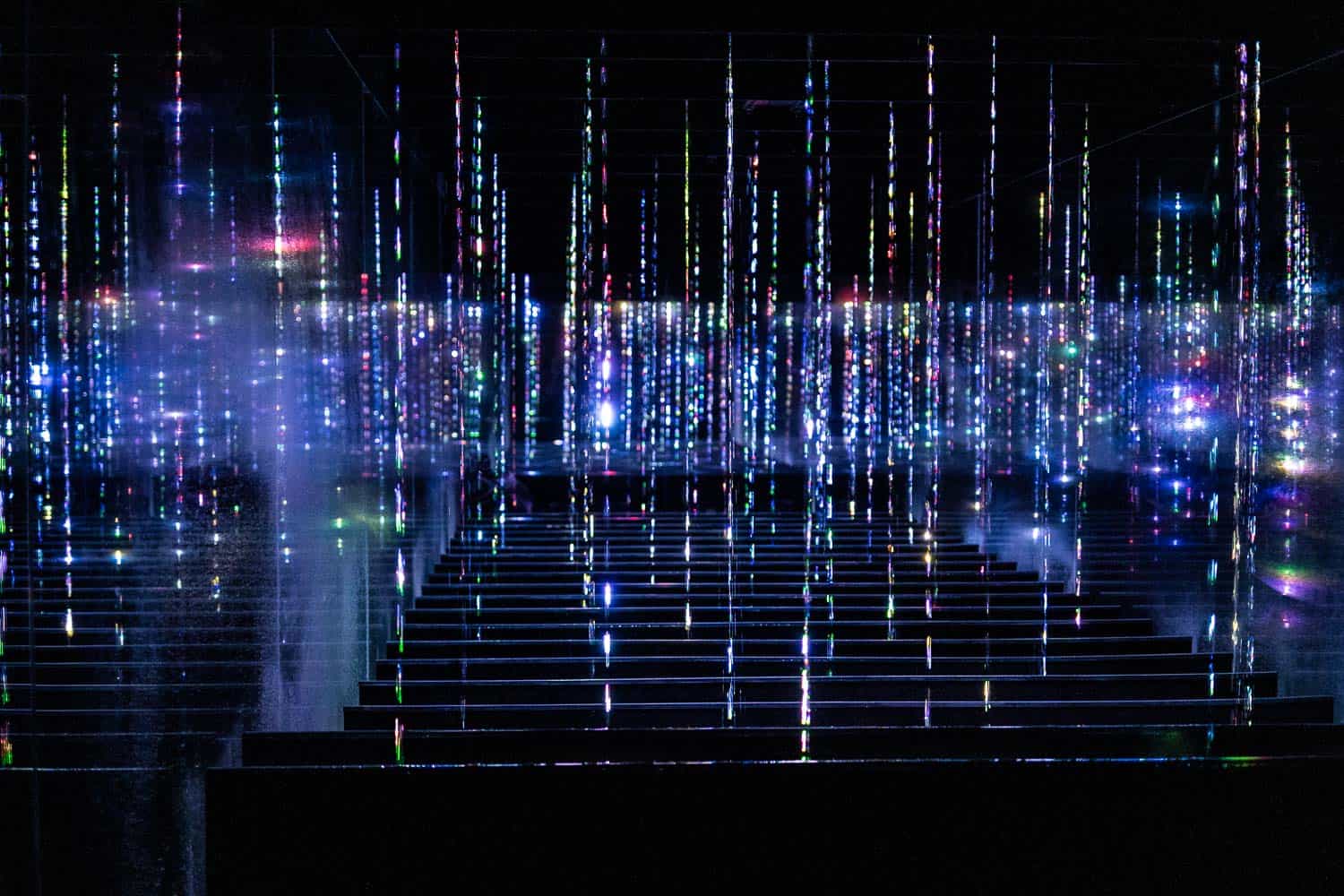
Things got brighter as we entered The Infinite Crystal Universe—or the Crystal Maze, as we call it. You can also find this room at TeamLab Borderless in Tokyo and TeamLab Biovortex in Kyoto.
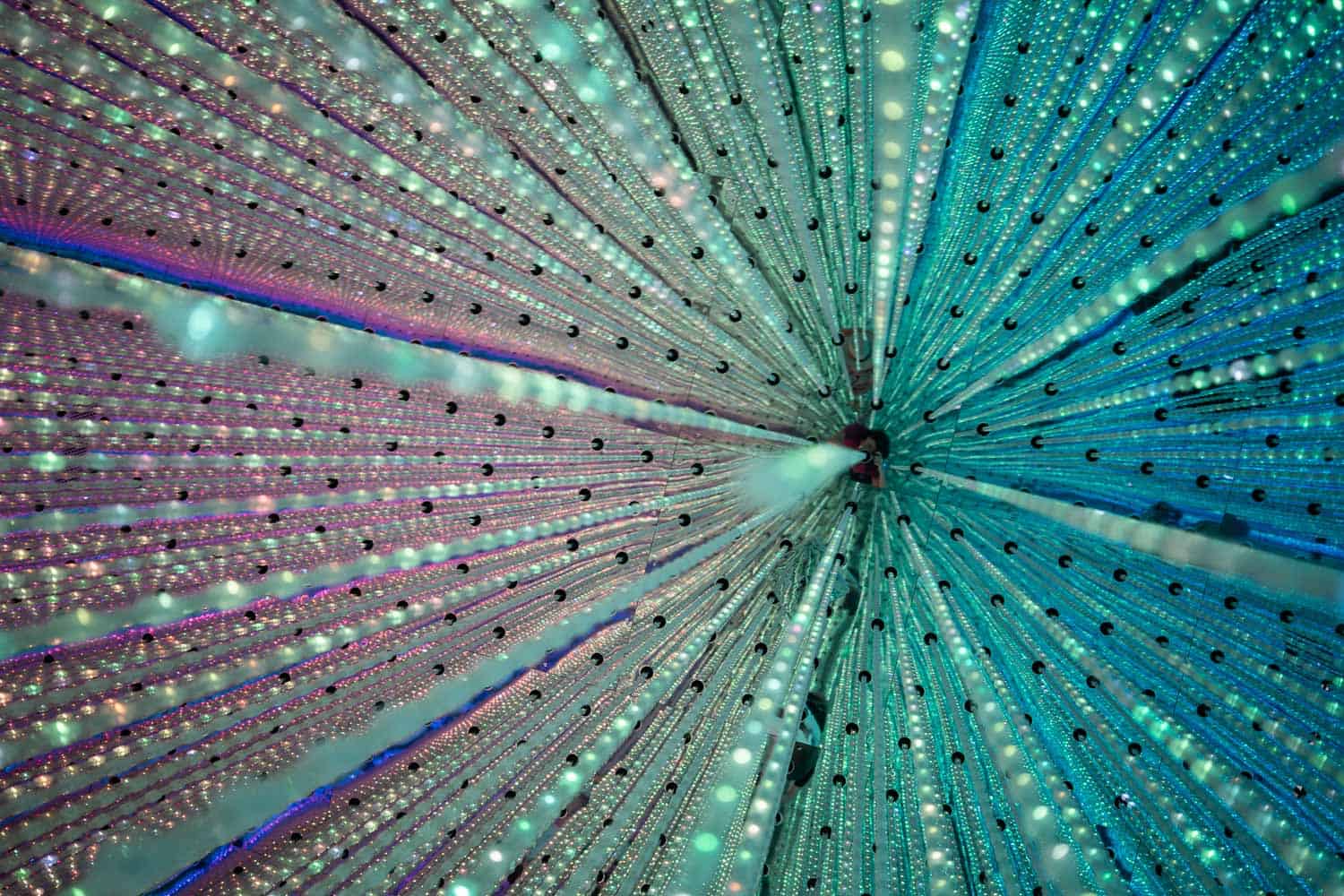
Strings of LED lights hang from the ceiling in this large room, the lights changing colour, and the mirrored floor adds to the feeling of infinite space.


The TeamLab app allows you to participate in the art, but Simon couldn’t get it to work very well.
We loved exploring this surreal space.
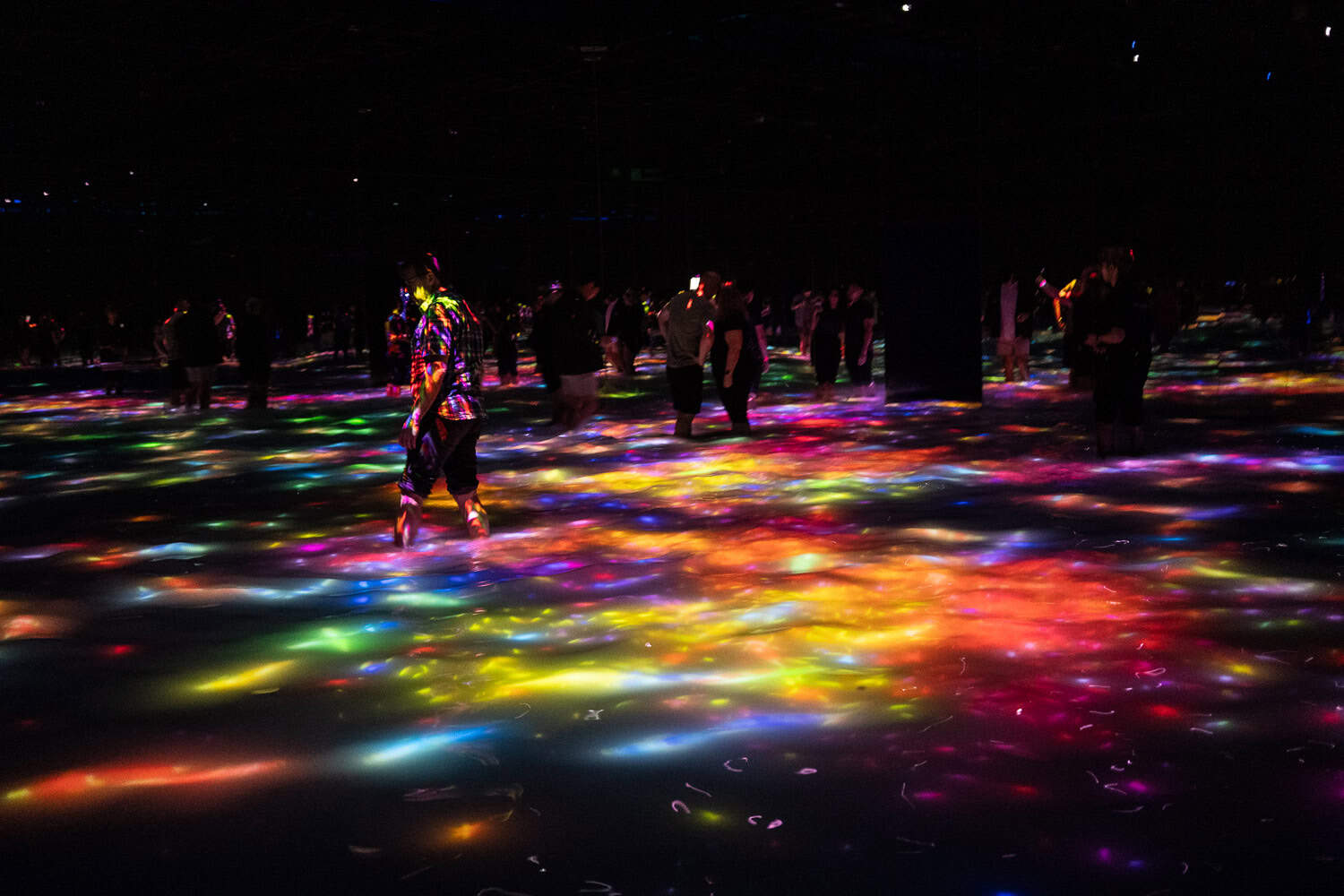
The Koi Pond was next and another favourite. You walk across a dark room filled with warm water, where projections of colourful koi swim across it. When you collide with a fish, it transforms into a flower.
It’s not prerecorded or on a loop, so it’s never the same.
Don’t miss the side room off the pond called Ephemeral Solidified Light. Streams of water fall, and as you put your hand near, the other streams go dark so you can conduct your own light show.
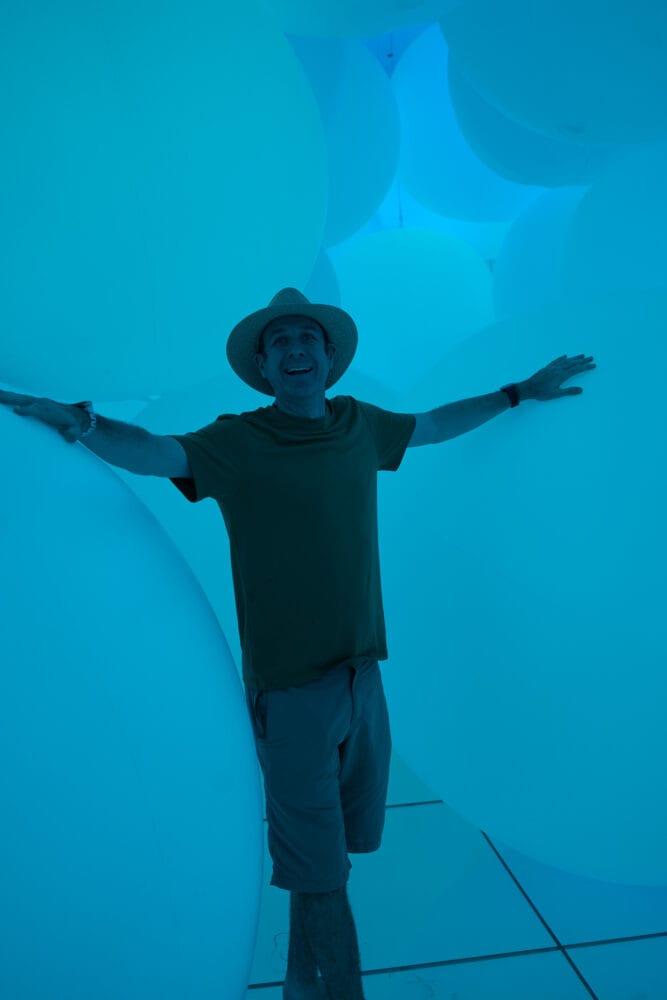
Back on dry land, we passed through a room of giant coloured spheres—when you touch the balls, they change colour and play a sound.
The final room on the Water side is Floating in the Falling Universe of Flowers. We loved how relaxing this one was (please be quiet to keep it that way!).

You sit or lie in the middle of the room and look up at the images of vibrant flowers projected on the walls and ceiling. They constantly change, and you see them bloom, wither, and die. There’s even a flower smell.
It’s quite a trippy experience, and it can feel like the floor is moving. Be careful as you stand up, as it’s disorientating.
On our first visit to TeamLab Planets, we loved it so much that after returning to the locker room, we did another tour around the Water area. We didn’t take photos this time, but immersed ourselves in the otherworldly atmosphere.
Garden Area
After Water, you return to the locker room to collect your shoes and other items (you can leave things here, but it makes more sense to use the Forest lockers). You can also use the restrooms if needed.
Garden is the next area, featuring two live gardens. This area is not projection-focused like Water, and it uses natural light.
First, visit the Floating Flower Garden. You might have a short wait to enter (we didn’t on our second visit).

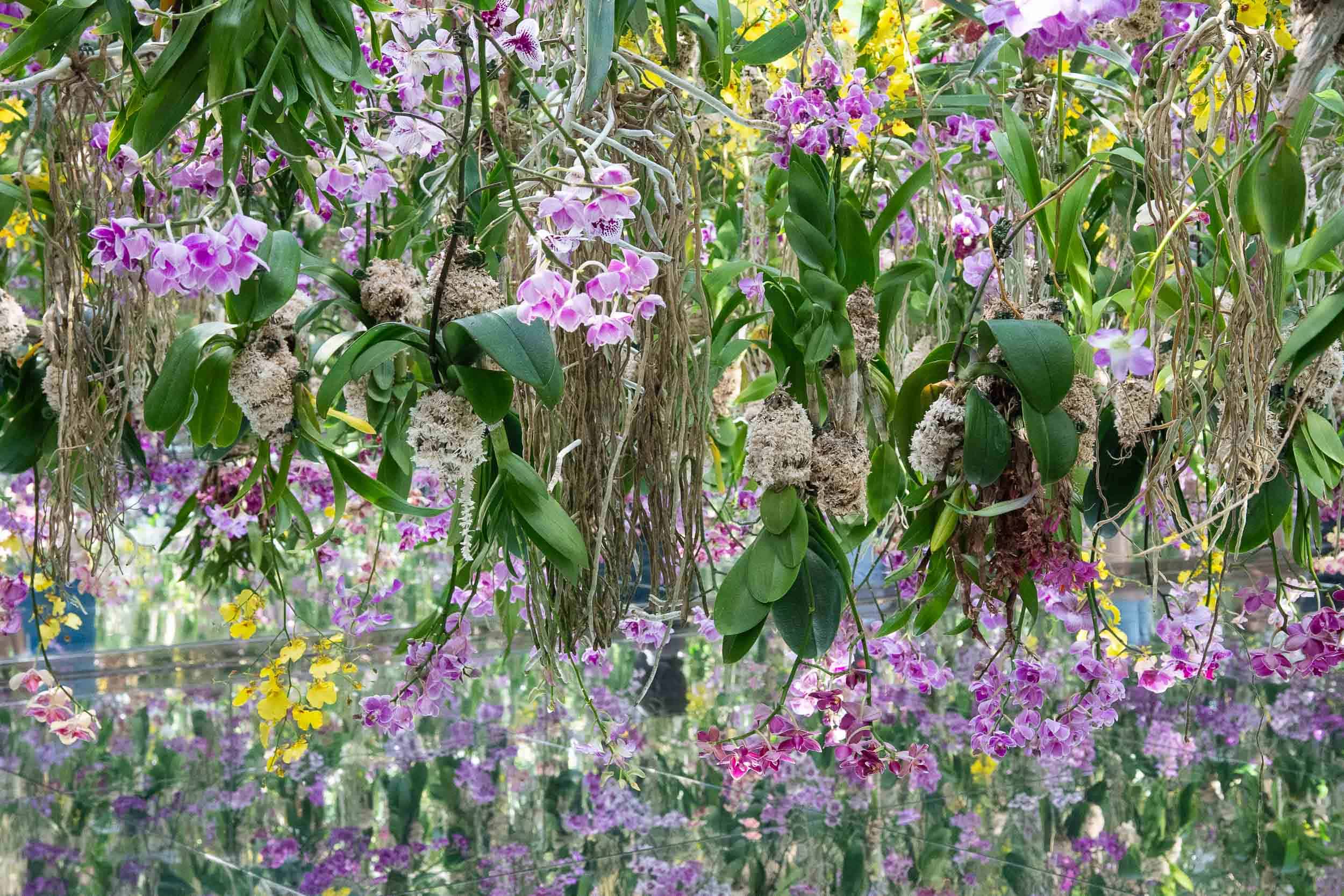
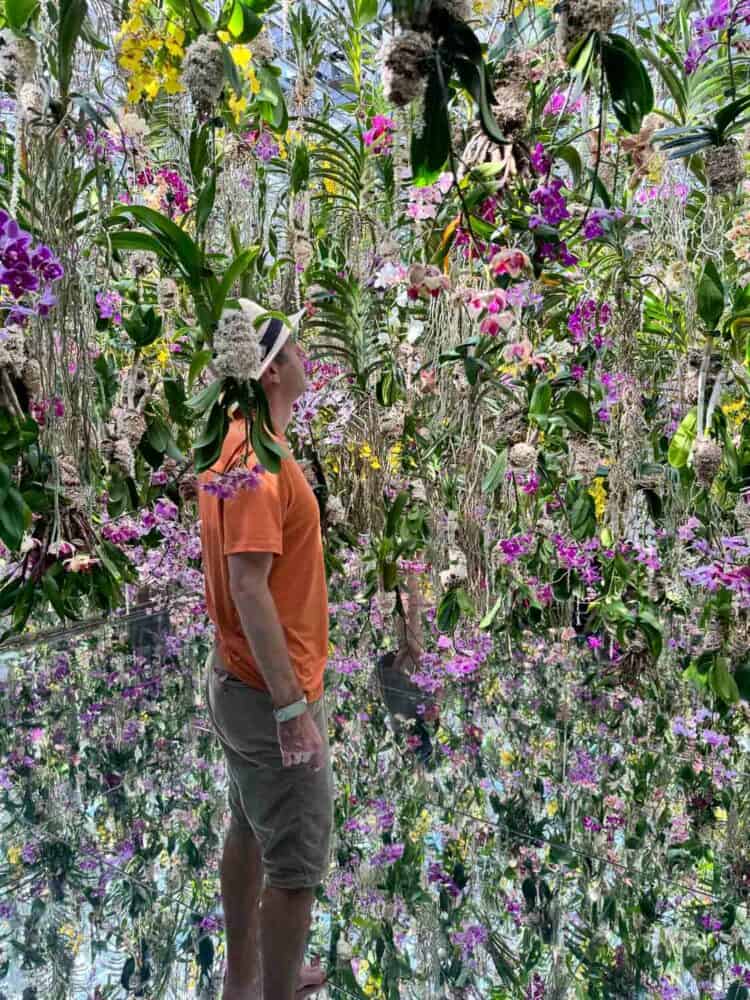
This is such a beautiful place, with real orchids hanging from the ceiling, moving up and down so you can go underneath. The mirrored floor magnifies the effect.
The exhibit is possible because orchids can grow without soil, absorbing water from the air.
The Moss Garden of Resonating Microcosms is outside on the way to the Forest area. The small moss garden is full of reflective silver ovoids with mist rising between them.
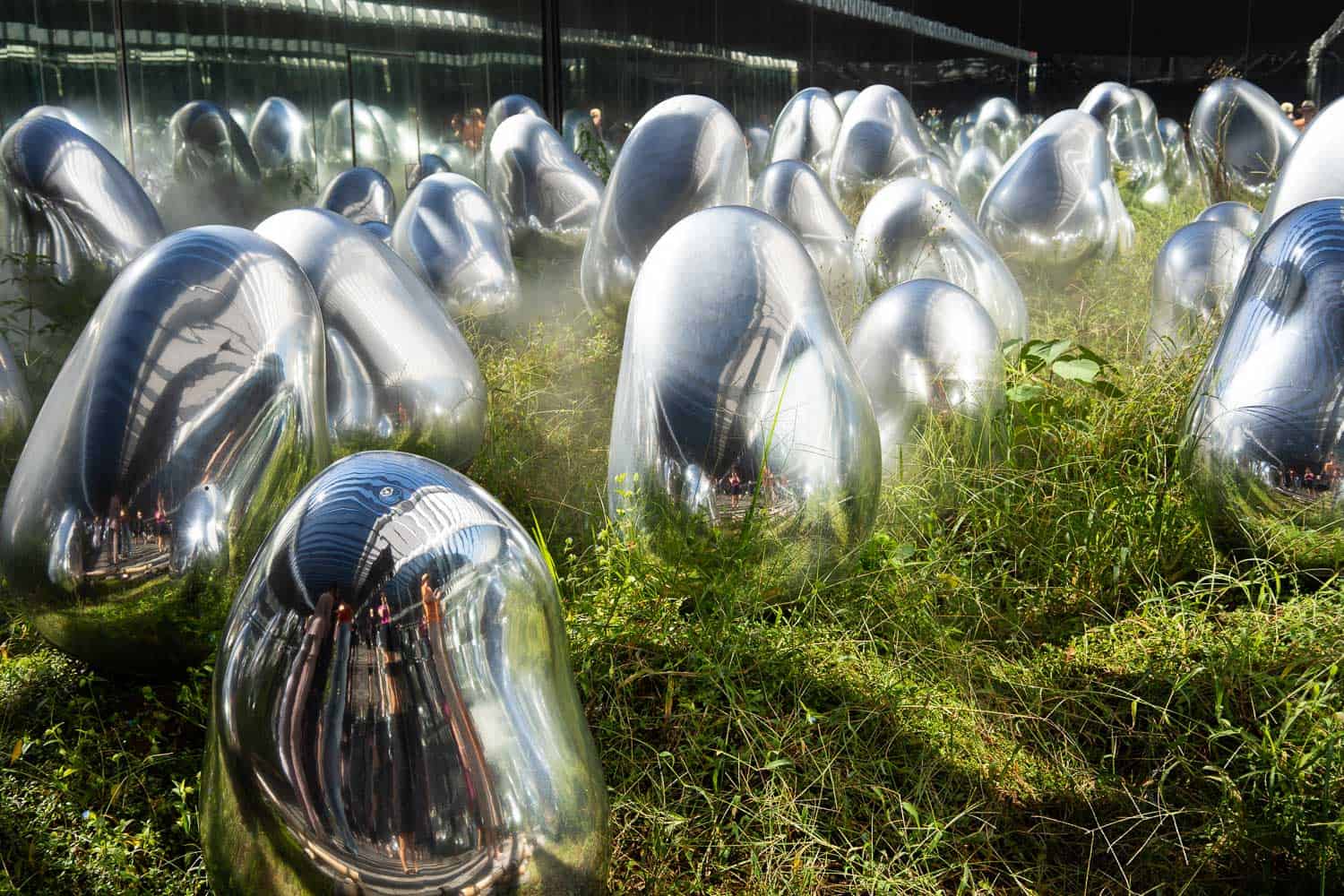
One of the advantages of visiting TeamLab Planets after sunset is seeing the ovoids glow in multiple colours. It looks very different after dark.
Forest Area
Forest is the newest area of TeamLab Planets (it opened in January 2025), and it really makes the museum much more substantial.
The whole area is very interactive and ideal for kids, although we found it fun as adults too.
If you have children, you might want to start with this area, as it gets busy and you can expect queues for the activities. We got here an hour after opening, and it felt much busier than the other areas.
At the entrance to Forest, there’s a locker room and a place to rent shoes (since you can’t wear heels or sandals inside). You also watch a short video before entering, and you might have to wait to get inside.
You can then choose between two rooms.
We started in Catching and Collecting Forest, a beautiful space where colourful creatures roam the walls under the sea or in the forest.
You can use your smartphone to catch, learn about, and release the extinct animals. You are shown a video explaining how this works and have to download a separate app. The app didn’t work perfectly, but it’s a cool concept.

Even without using the app, it’s a magical place to wander. It was a highlight of the museum for us, and we spent quite a while here. It didn’t feel too busy, and it’s bigger than you think, so head into the back rooms.


The other part of Forest is Athletics Forest, an interactive play area where you challenge your body in three-dimensional spaces, jumping, climbing and sliding.


This area felt a lot more chaotic, and you will need to queue for the activities, so we didn’t do them all.
Within Athletics Forest is Future Park, where you can sketch on walls with a light pen or colour in a picture at Sketch Umwelt World.
We enjoyed this, as it was a relaxing break from the museum. You choose an outline of a flying creature (Simon went for a plane, and I did a butterfly) and colour it in however you like with crayons.
Staff will then scan it in, and you can see it appear on the wall. You can even download another app to control its movements.

You can also buy products such as badges and t-shirts featuring your design.
There is a very similar Athletics Forest area in the new TeamLab Biovortex in Kyoto.
Open-Air
In 2025, the outside area of TeamLab Planets was expanded, and you can now only visit it after you’ve entered the museum.
Out here, you can find refreshments, seating, and restrooms. Cash isn’t accepted, so bring a card (contactless works).

There’s also a fiery, tower-like artwork, Universe of Fire Particles Falling from the Sky, that interacts with an app.

For a quick snack, there’s a stand where you can pick up vegan ice pops, cookies, and doughnuts. The ice pop and cookie we tried were tasty.
For something more substantial, there’s delicious vegan ramen (more below).
Or if you want a drink, a new space outside is Orchid Glass House, where you can drink tea and sake and watch orchids from the Floating Flower Garden grow back after their flowers have fallen. It looks magical!
It’s for over 12s only, and it only seats a few people, so you might have to wait.
There is an entry fee of 1600 yen ($10), which includes an orchid, although this isn’t very useful for international travellers.
In addition, drinks range from 800 yen ($5) for cold Moon Tea to 1200-2200 yen ($8-14) for sake.
As we had ramen, we didn’t go inside here.
UZU Ramen
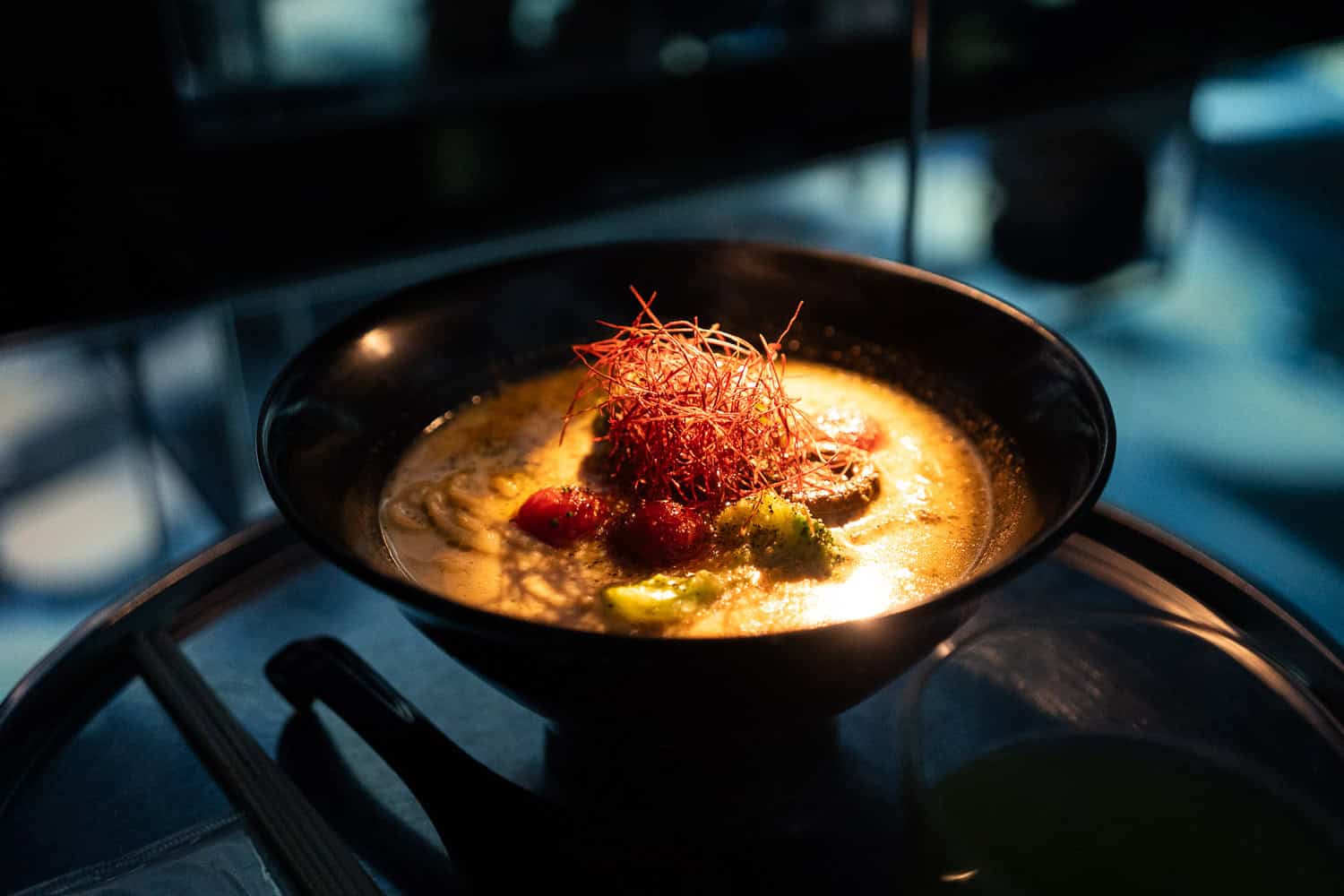
Outside TeamLab is our favourite ramen place in Tokyo—Vegan Ramen UZU. I highly recommend having a meal here after your visit.
You used to be able to eat here without a museum ticket, but that is no longer possible. You can only visit after you have entered the museum.
There are two places to get the ramen. Outside is the casual Cafe Uzu, where you can order the ramen (2000 yen/$13), drinks, muffins, cookies, or ice cream. Everything is vegan.

Or you eat inside the art room, Black Emptiness Table. To eat here, you must order the ramen set for 3000 yen ($19), which includes a drink. It’s only a 400 yen surcharge on eating outside, and I think it’s worth it.
There’s minimal space inside, so you may have to wait. We got straight in at 11am just as it opened.
Inside, it’s pitch black, and as the first ones in, it was quite disorientating. They guided us to our seats with a light. We sat around a large mirrored table featuring swirling art called Spatial Calligraphy.
When your ramen arrives, they turn on a light above so you can see what you are eating.
There’s only one type of vegan ramen available, and it is delicious. The miso oat milk broth is flavourful, the homemade noodles are pleasantly chewy, and it’s topped with roasted vegetables.
This is one of our favourite vegan restaurants in Tokyo. There’s also a branch in Kyoto that we recommend with more ramen choices and cool artwork—see our guide to vegetarian and vegan food in Kyoto.
What Are the Best Areas in TeamLab Planets?
Our favourite rooms are Floating in the Falling Universe of Flowers, the Koi Pond, Floating Flower Garden (orchids), and Catching and Collecting Extinct Forest.
How to Get to TeamLab Planets
TeamLab Planets can be reached by train and subway from across Tokyo. These are the nearest stations:
- Shin-Toyosu Station (Yurikamome Line) – 1 minute on foot.
- Toyosu Station (Yurakucho Line) – 10 minutes on foot (this is the most useful station).
- Shijoumae Station – 5 minutes on foot.
You can use Google Maps to find the best route from your hotel.
The downside of an early start slot at TeamLab is having to travel at rush hour—expect crowded trains.
On our first visit, we left Shimokitazawa (near Shibuya) at 7.30am and had to stand the whole way (a one-hour journey with transfers).
On our second visit, we stayed closer to the museum in Shimbashi, near Ginza (at the excellent Blossom Hibiya), and chose to take an Uber instead. It only took 10 minutes and was much easier. It cost 2800 yen ($18).
Tokyo Station to TeamLab Planets
TeamLab Planets is easiest to reach from this side of Tokyo. Walk a few minutes to Yurakucho Station and take the Yurakucho Line directly to Toyosu Station (8 minutes), then walk 10 minutes.
Or take the JR Yamanote Line to Yurakucho (2 minutes) and change.
Shinjuku Station to TeamLab Planets
From Shinjuku Station, take the Shinjuku Line to Ichigaya Station, then switch to the Yurakucho Line to Toyosu Station. Allow about 45 minutes to one hour for the trip.
Ginza to TeamLab Planets
A shuttle bus runs between GINZA SIX and teamLab Planets. You can only buy the ticket on Klook.
What to Visit Near TeamLab Planets
Toyosu Market is a 5-10-minute walk from TeamLab Planets and is popular for its fish market.
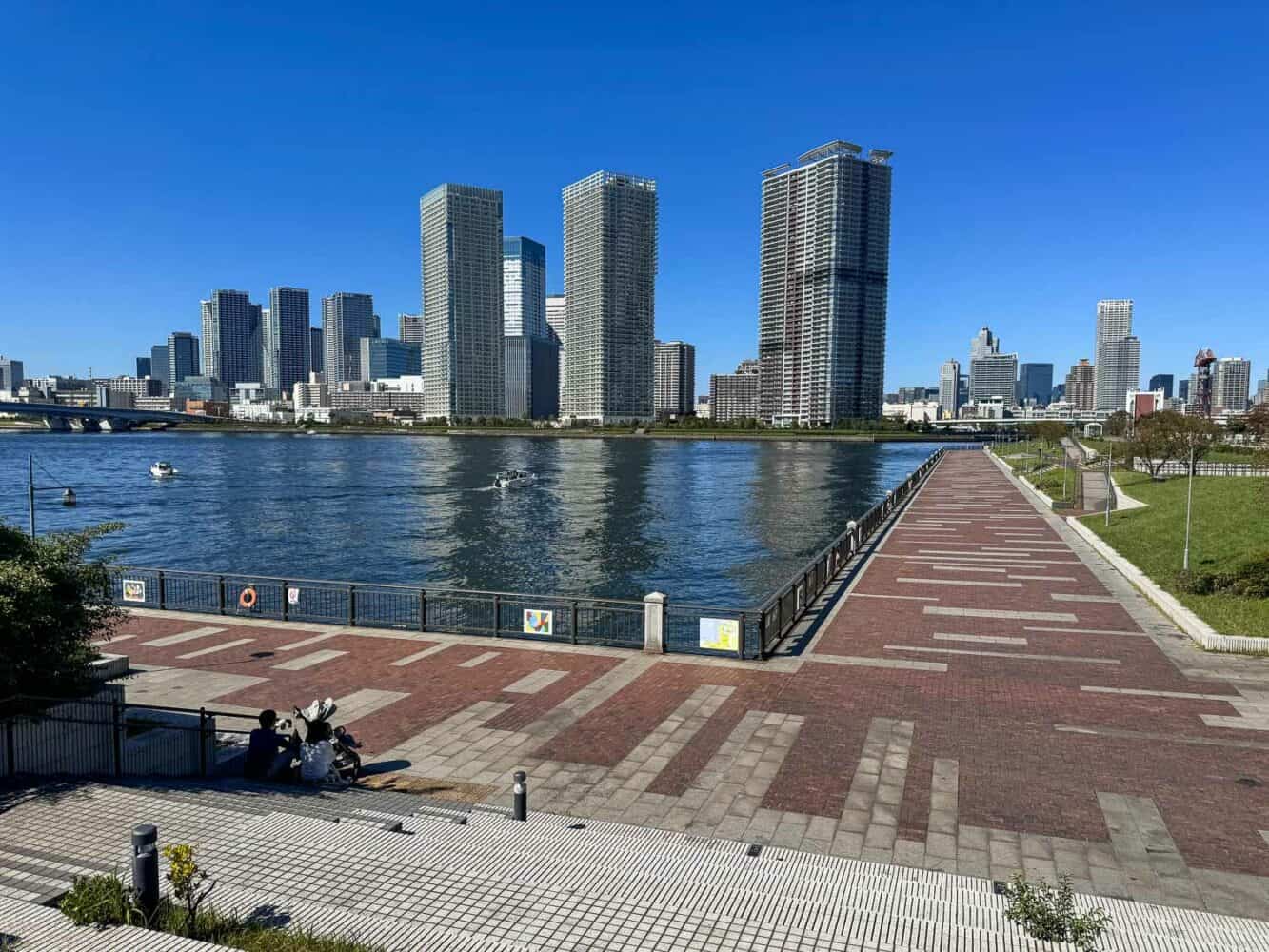
As vegetarians, we didn’t visit the market. Instead, we walked down to Toyosu Park on the way back to the station. On a sunny day, it was very pleasant with views of the canal. The open space felt good after being in more crowded parts of Tokyo.
TeamLab Planets vs Borderless

Are you wondering whether to visit TeamLab Planets or TeamLab Borderless in Tokyo?
Firstly, know that they are both stunning exhibitions with a similar style, and you can’t go wrong with either.
I’ll be writing a detailed comparison of TeamLab Planets vs Borderless vs Biovortex (the new Kyoto museum) soon.
If I had to choose, I would say visit TeamLab Planets as it closes in 2027, it has delicious ramen, and it has a diverse range of attractions, including water (which the other museums don’t have).
See my TeamLab Borderless review and TeamLab Biovortex Kyoto review for more details about these amazing museums. We visited all three on our last trip and truly love them.
Is TeamLab Planets Worth It?
Yes, TeamLab Planets is definitely worth visiting! It’s one of our favourite things to do in Tokyo.
We love how creative, colourful, and interactive the exhibition is. While it is great for photo ops (despite lighting challenges), we found it even more magical when we did a second loop without taking photos. It’s a place that lifts our spirits.
The price is reasonable for the quality of the exhibition, and while it is a bit out of the way, I think it’s worth the effort to get there.
More Japan Posts
Read more of our travel tips for Tokyo and elsewhere in Japan.
TeamLab Reviews
Our Tokyo Travel Guides
- 26 Cool Things to Do in Tokyo
- 18 Best Things to Do in Shinjuku, Tokyo
- 18 Best Vegetarian Restaurants in Tokyo
- Robot Restaurant: The Most Insane Show in Tokyo
- 14 Best Tokyo DisneySea Rides for Adults
- 14 Best Tokyo Disneyland Rides for Adults
Elsewhere in Japan
- Planning a Trip to Japan: Dos and Don’ts
- 56 Best Things to Do in Japan for an Unforgettable Trip
- Two Weeks in Japan: A Detailed Itinerary
- Ghibli Park Review
If you enjoyed this post, pin it!


Hi there,
Thank you for such a detailed and insightful blog post! My husband and I are planning to visit next month and have also managed so secure the earliest timeslot.
We’d love to also try the vegan Ramen Place—may I ask how long you had to queue and wait for your food after teamlabs?
Thank you! :)
The ramen is so good! We got there at about 10.40am and queued for 5 minutes to order. We requested the table inside (with the artwork) and had to wait another 5 minutes to be seated there and then got our food 5 minutes after that, so about 15 minutes in total. It may be busier in April though (we were there mid-October). Enjoy!