This page contains affiliate links. Please read our disclosure for more info.
It’s easy to be vegetarian in Kyoto. As Japan’s ancient capital, it has a long tradition of shojin ryori or Zen Buddhist temple cuisine, which is entirely vegan and includes multiple small dishes using seasonal ingredients.
Eating in a temple is a highlight of a visit to the city, but there are many other vegetarian and vegan restaurants in Kyoto, both modern and traditional.
There is also an increasing number of traditional restaurants that specialise in one dish, like ramen or gyoza, that now provide meat-free options.
Planning is key. You will likely struggle if you wander into a random restaurant as dashi (fish broth) is used in many dishes.
We’ve spent over two months tracking down the best vegetarian food in Kyoto from casual ramen joints to sophisticated kaiseki (multi-course fine dining).
Here are our picks for the best vegetarian restaurants in Kyoto (including many vegan options) plus a map with everywhere mentioned.
Contents
- Tips for Being Vegetarian in Kyoto
- Vegan and Vegetarian Ramen in Kyoto
- Kyoto Vegetarian Restaurants
- Vegetarian-Friendly Restaurants in Kyoto
- International Vegan and Vegetarian Food in Kyoto
- Vegetarian Cooking Class in Kyoto
- Vegetarian Kyoto Map
- Summary
- More Japan Posts
Tips for Being Vegetarian in Kyoto
The Happy Cow website or app is the best resource for finding veggie-friendly meals nearby.
Make sure you have data on your phone so you can use Google Maps to find your way around. Airalo eSIMs are the easiest way to stay connected as you can set it up before you arrive.
Many of these restaurants are small, family-run places and were sometimes closed when we expected them to be open.
It’s worth checking their Instagram (or sometimes Facebook) pages before you visit for any unexpected closures (you may have to use Google Translate). It’s always a good idea to have a backup plan.
Note that some restaurants don’t accept credit cards. 7-Eleven is the best place to withdraw cash with international cards for free.
Downtown Kyoto and Gion are the best areas to stay to have veggie options nearby. See our guide to where to stay in Kyoto for our recommended hotels and ryokans.
Our vegetarian Japan guide has lots more tips.
Vegan and Vegetarian Ramen in Kyoto
I don’t think we found a single vegetarian ramen in Kyoto on our first visit back in 2011, so it has been a joy to see the increasing number of plant-based ramens on offer in the city. Here are just some of them.
1) Vegan Ramen Uzu (TOP PICK)

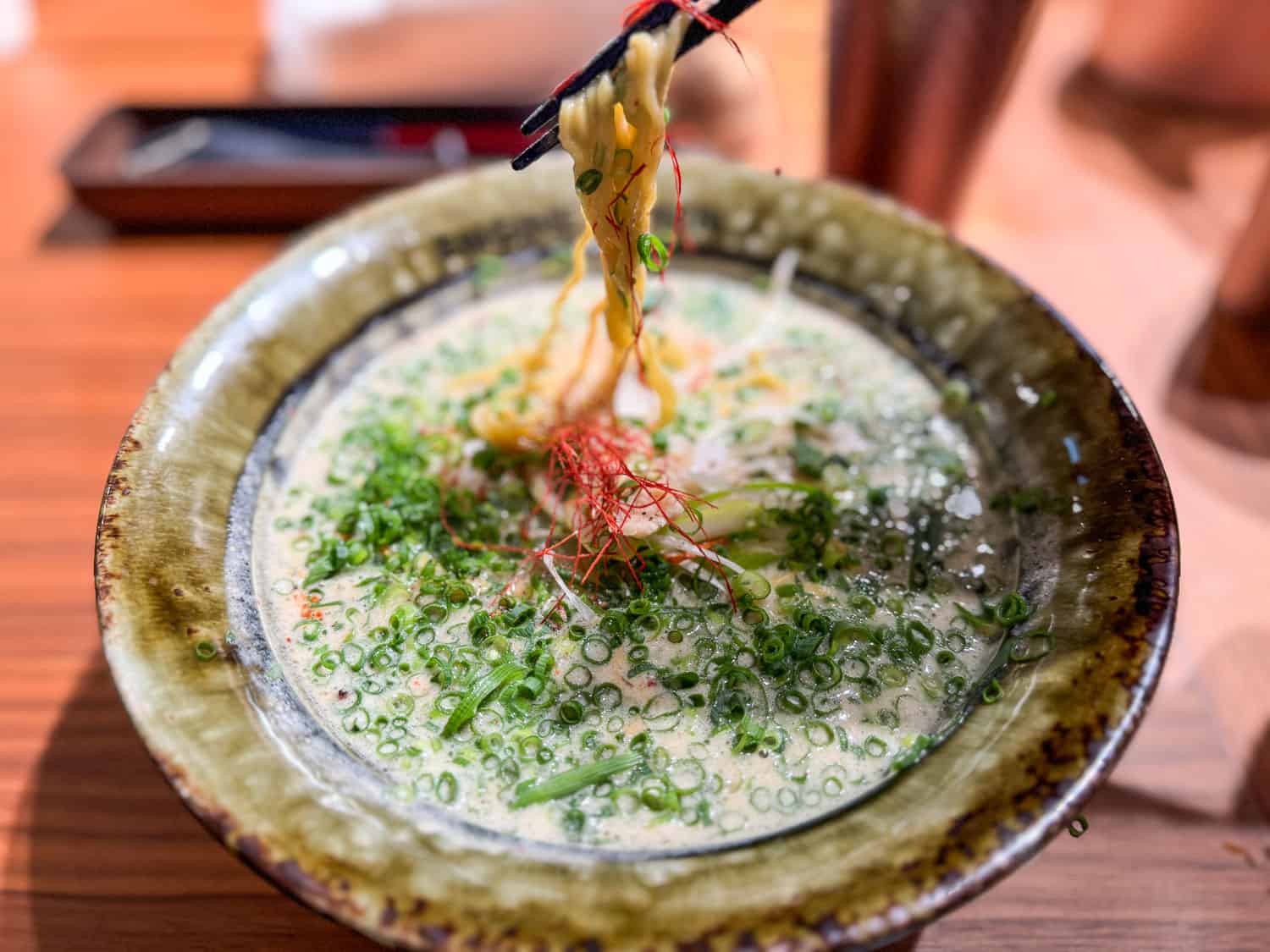
Uzu has the best vegan ramen in Kyoto. Not only is the broth flavourful and the noodles perfectly chewy, but it’s a whole experience.
You eat in a serene, darkened room with teamLab artwork projected on the wall and reflected on the communal table.
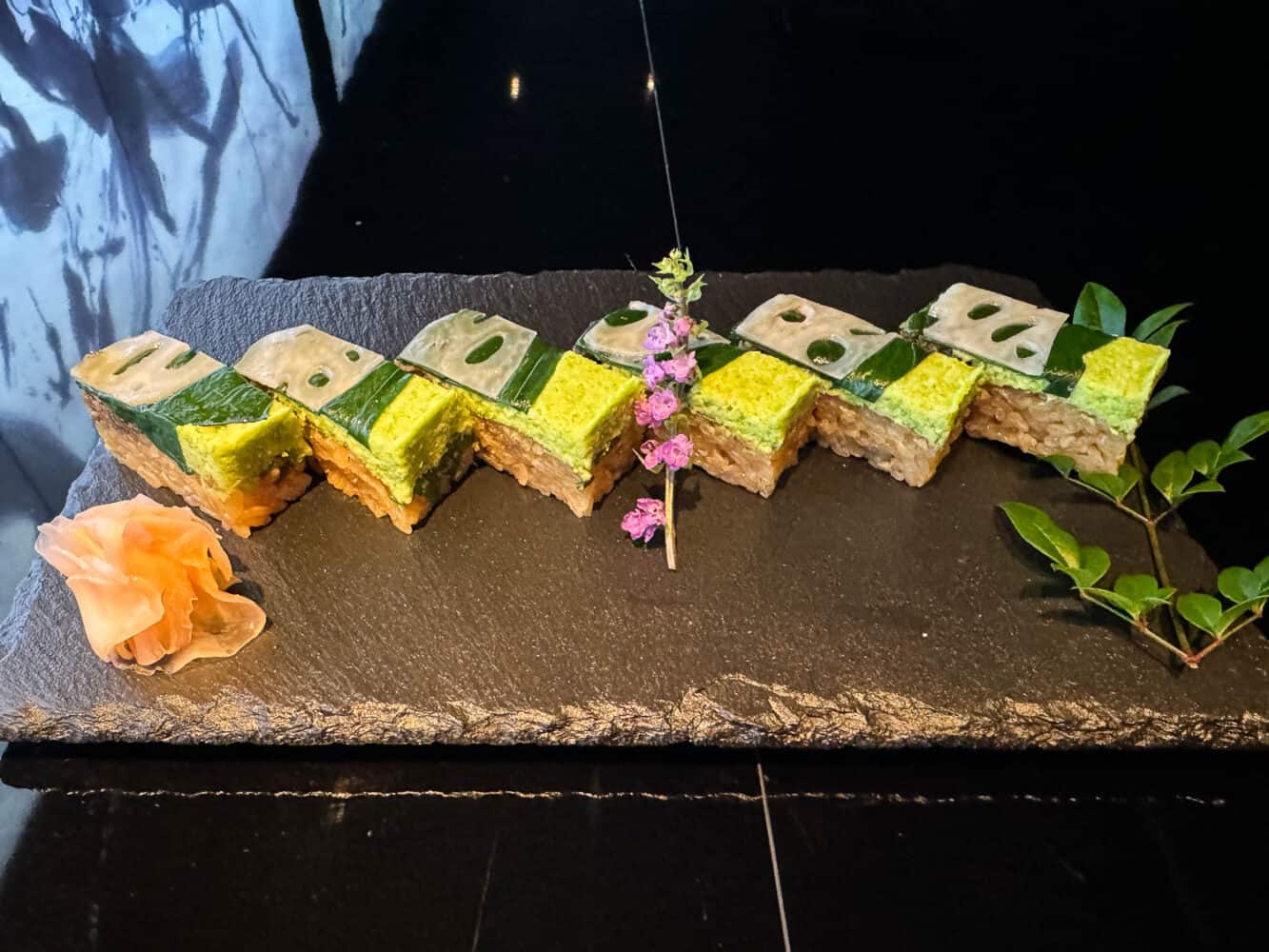
Every aspect of our meal was superb—the delicious sushi we began with, the rose kombucha, and the pistachio ice cream with matcha sauce for dessert.
Of course, the ramen is the star of the show with five types available. Simon enjoyed his Tsukemen (sichuan pepper spicy miso), a rich peppery broth without toppings and noodles on the side.
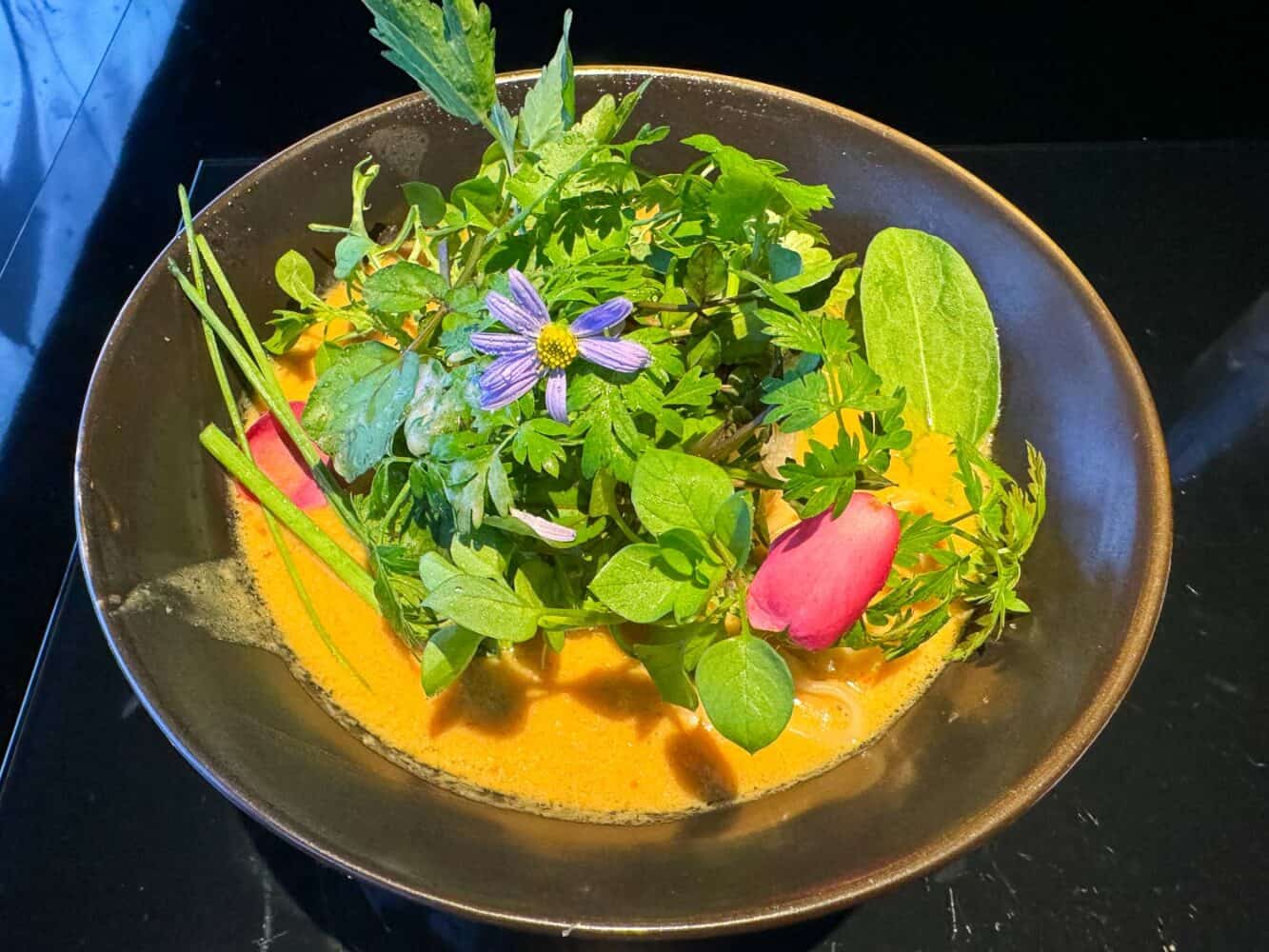
My Mountain Herbs ramen was even better featuring eight wild plants and a spicy miso broth with a depth of flavour we didn’t find in other vegan ramens.
Uzu is not a budget ramen joint, but the quality of the food and atmosphere (and the fact that it’s 100% vegan) was worth it to us. Make sure to book at least a few weeks in advance in high season.
We also love the Uzu ramen shop at TeamLabs Planets in Tokyo (see our Tokyo vegetarian guide), but they only have one type of ramen, and we prefer the Kyoto branch.
Location: 146 Umenokicho. It’s a little out the way, a 15-minute walk north of the Kawaramachi shopping area.
Hours: Open Tuesday – Friday from 11.30am – 3pm and 5.30pm – 9.30pm. Closed Saturday, Sunday and Monday.
Credit cards accepted: Yes.
Website: Vegan Ramen Uzu. You can make a reservation on Tablecheck.
2) Gion Soy Milk Ramen – Uno Yokiko (TOP PICK)
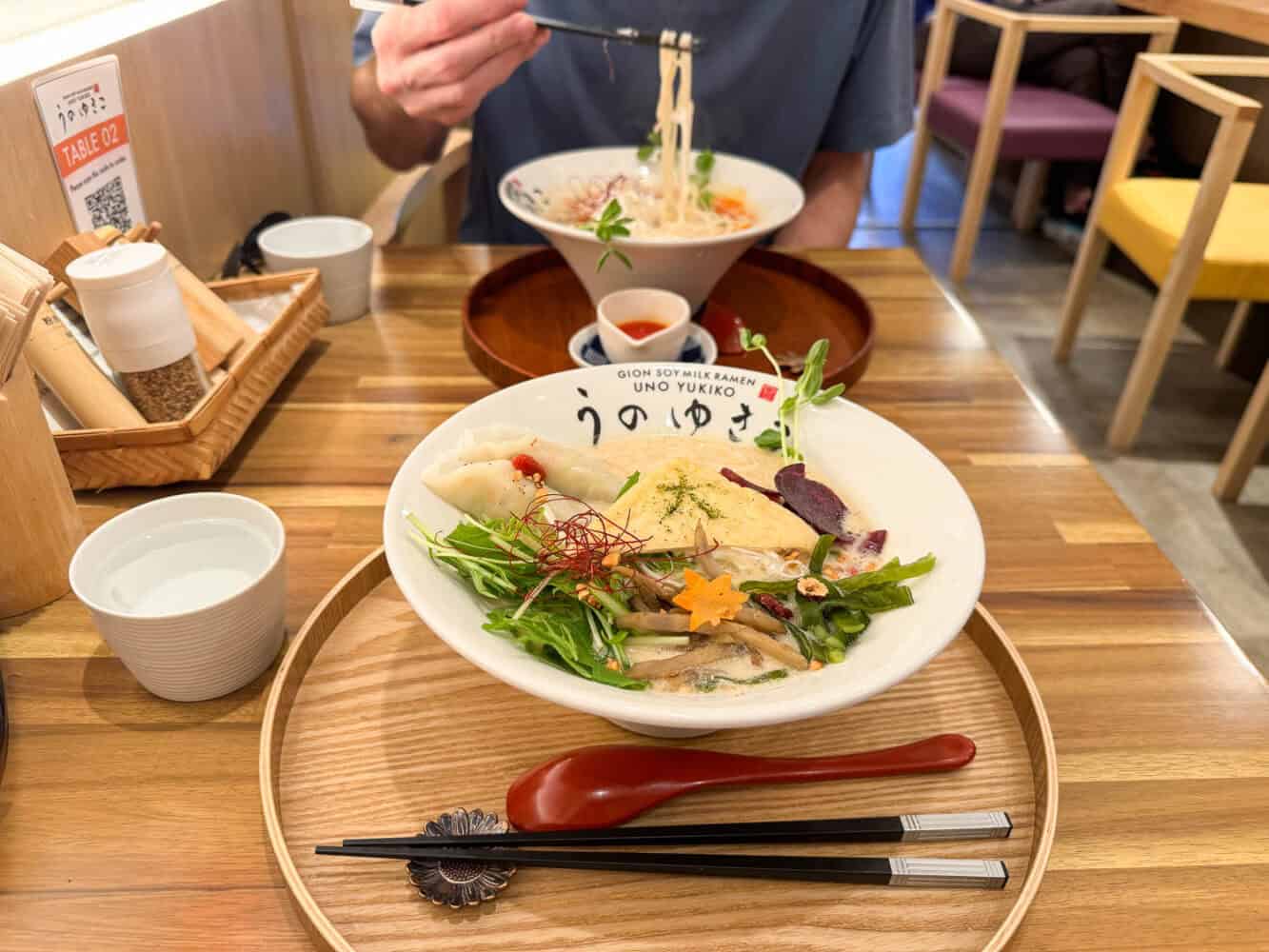
Uno Yokiko is another vegan ramen shop that we really enjoyed. It’s a fantastic option for vegans sightseeing in the Gion area.
They offer a variety of plant-based, gluten-free ramen with noodles made of rice and kelp.
Decor is simple and you order via a QR code at your table then pay on your way out. We found the menu a bit confusing despite being in English.
All the soups have a soy milk base and the cheapest options have minimal toppings (mostly soy meat chunks). Dandan adds spice with a sesame and chilli oil on the side (Simon got this).
I went for Hana, which is the basic broth topped with lots of vegetables, gyoza, and yuba. I was worried the broth might be plain, but it was full of flavour, and there are spices on the table if you need a kick.
They also have gyoza, soy nuggets, and vegan desserts. Their takeaway packet ramen makes for an easy meal later—just boil the noodles and add water to the soup mix.
Location: 40 Kameicho, Gion.
Hours: Open 11am – 8.30pm every day.
Credit cards accepted: Yes.
Website: Gion Soy Milk Ramen.
3) Kyoto Engine Ramen
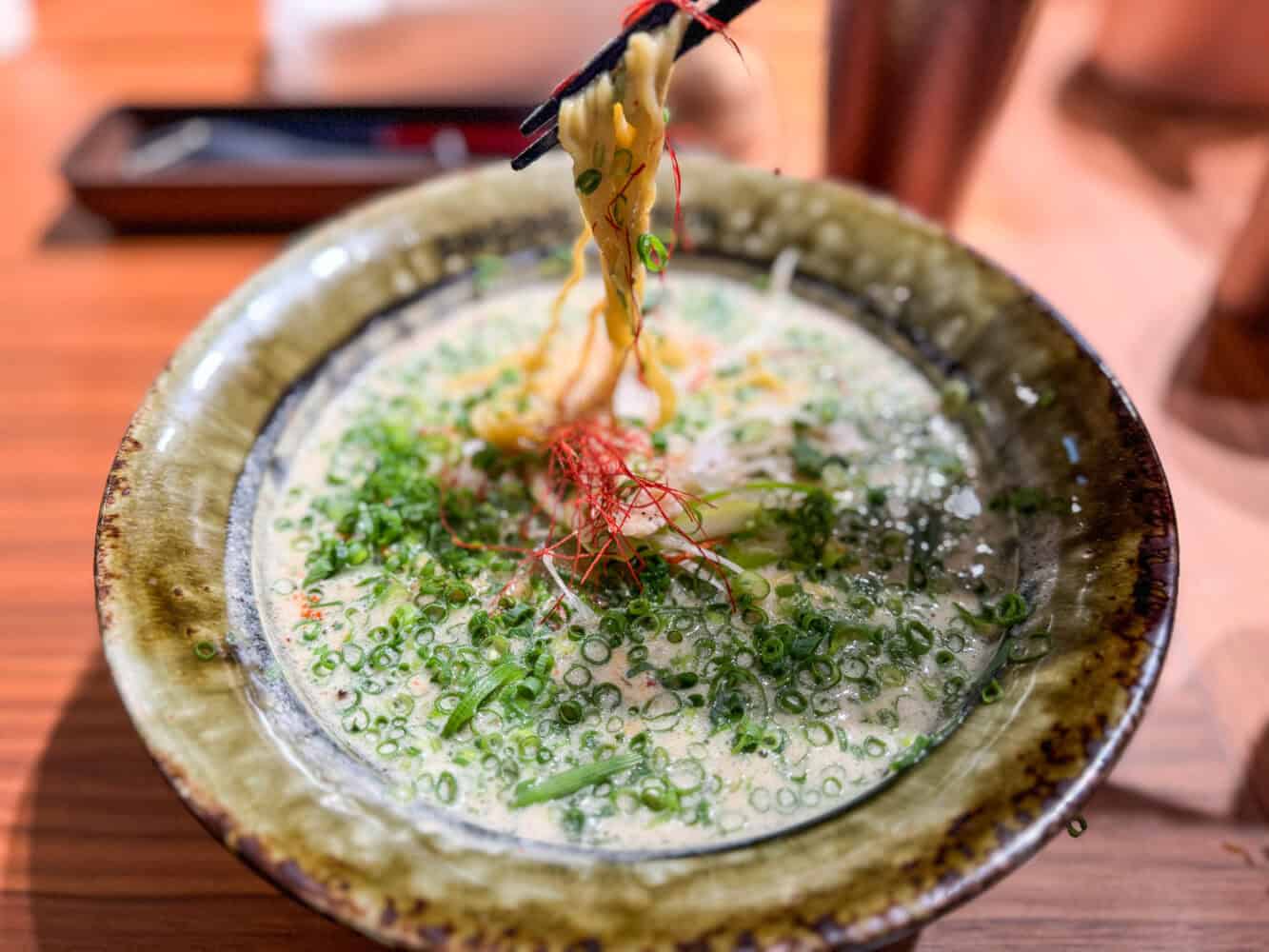
Kyoto Engine Ramen is very popular with foreigners as they have vegan, halal, and gluten-free options, and it’s in a central downtown location.
While they do serve meat here, they also have two vegan ramens, both of which are soy milk based. The Zesty is spicy so that’s what we chose. Toppings are minimal (mostly green onions) but the broth is tasty.
It’s not a must visit for me, but some people rave about it, and it’s worth a visit if you are in the area. Expect to queue though (and probably share a table) in this bustling spot. We waited 15 minutes at 5.45pm but the queue was a lot longer by the time we left.
Location: 580-2 Nakanocho in the Kawaramachi shopping area.
Hours: Open from 12pm – 11pm every day (lunch opening is on a trial basis).
Credit cards accepted: Yes.
Website: Instagram.
4) Tokkyu Ramen
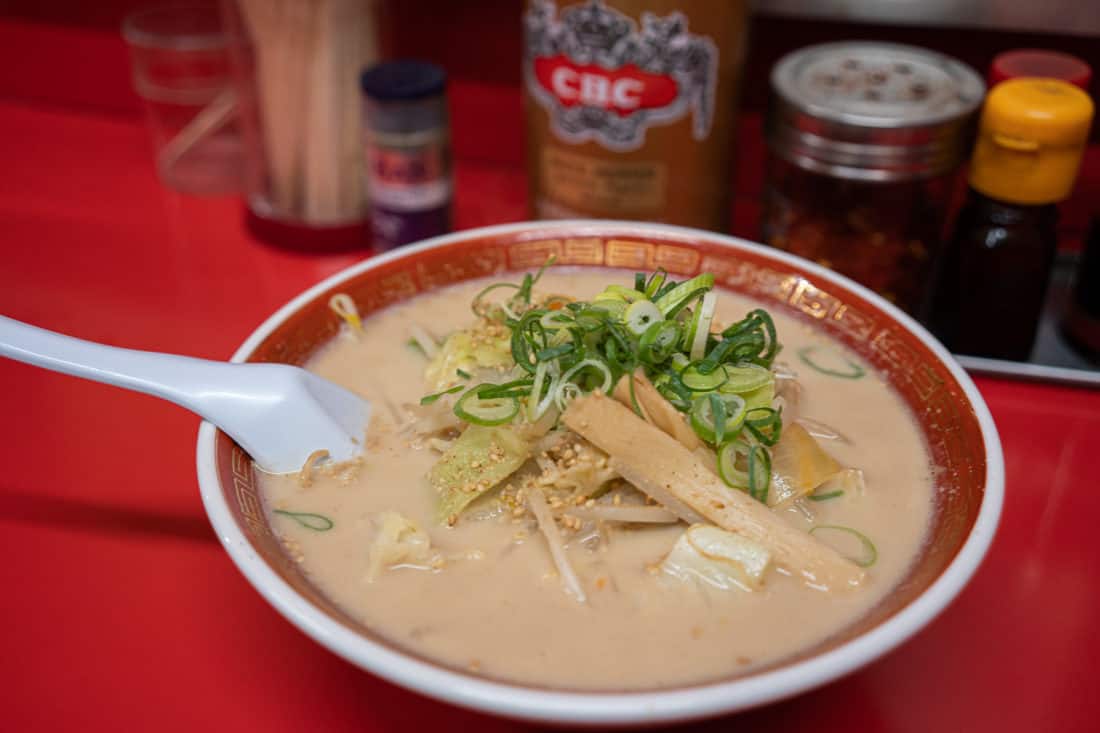
This basic, counter-seating ramen joint near Yasaka shrine has no English sign so look for the red lantern and hand-written sign saying vegan and vegetarian ramen.
They offer one vegan ramen made with a creamy sesame miso broth topped with bean sprouts, cabbage, green onions, bamboo shoots, and sesame seeds.
It’s available in medium (plenty for me) and large (huge but Simon managed it!) and is excellent value at 950 yen ($6) for a medium.
It’s not our favourite vegetarian ramen in Kyoto, but it’s quick, affordable, and the location is convenient when sightseeing in Gion.
Location: 30–4 Bishamonchō, Gion.
Hours: Open 11.30am – 8pm. Closed Wednesday.
Credit cards accepted: No.
Website: Happy Cow
Kyoto Vegetarian Restaurants
All these restaurants and cafes are entirely vegetarian (most are vegan), so you can safely choose anything from the menu.
Uzu and Uno Yokiko in the ramen section above are also 100% vegan.
5) Shigetsu (TOP PICK)
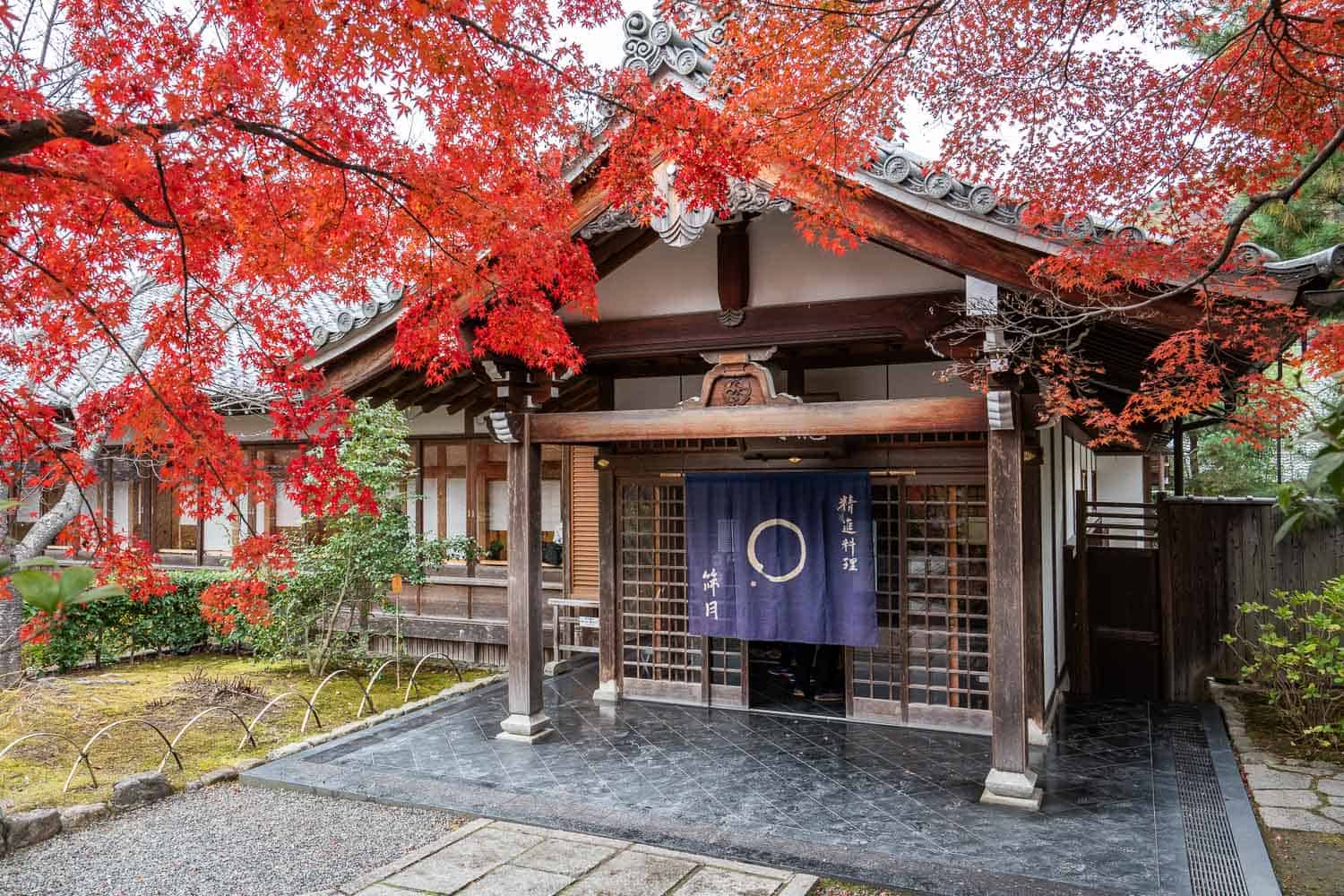
The best place to try Zen Buddhist cuisine or shojin ryori in Kyoto is at Shigetsu inside Tenryu-ji temple. The food is entirely vegan.
It’s located in the Arashiyama neighbourhood in the western hills and you can combine lunch with a day visiting the temples, bamboo forest, and other attractions in this lovely area.
See my detailed guide to the best things to do in Kyoto for more sightseeing tips.
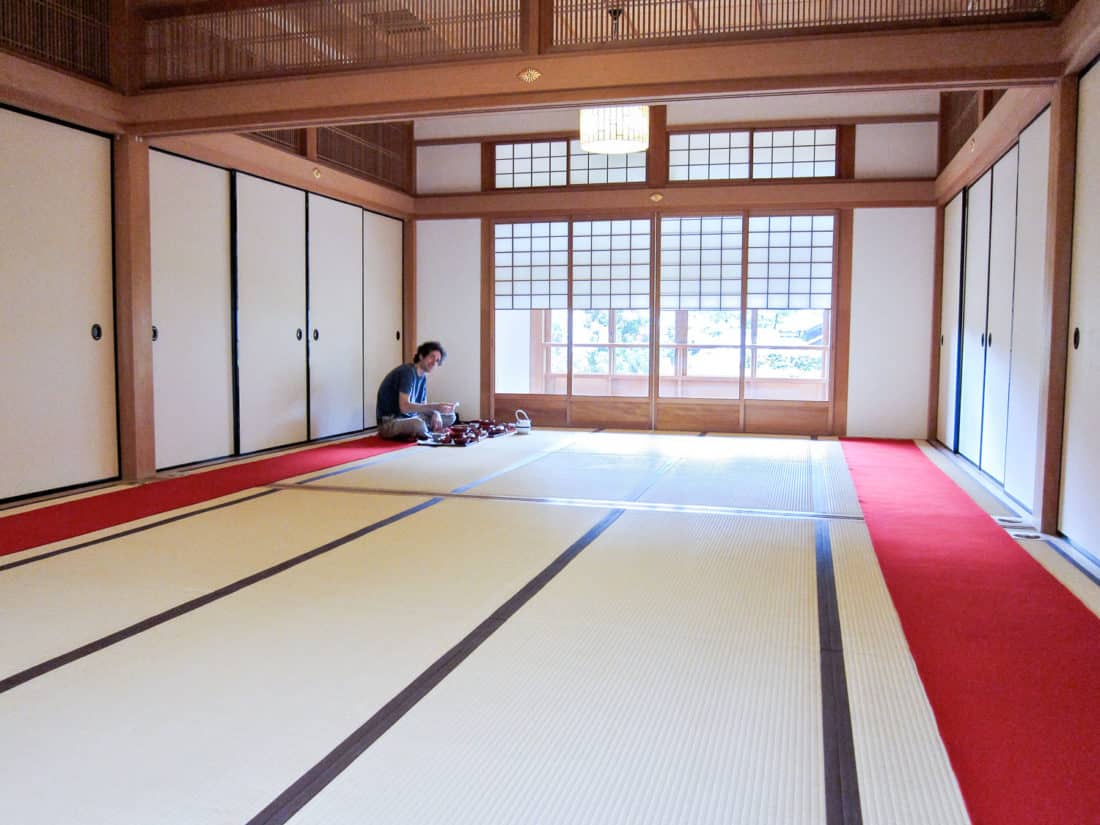
You dine on the floor in a large tatami mat room with views of the temple’s garden.
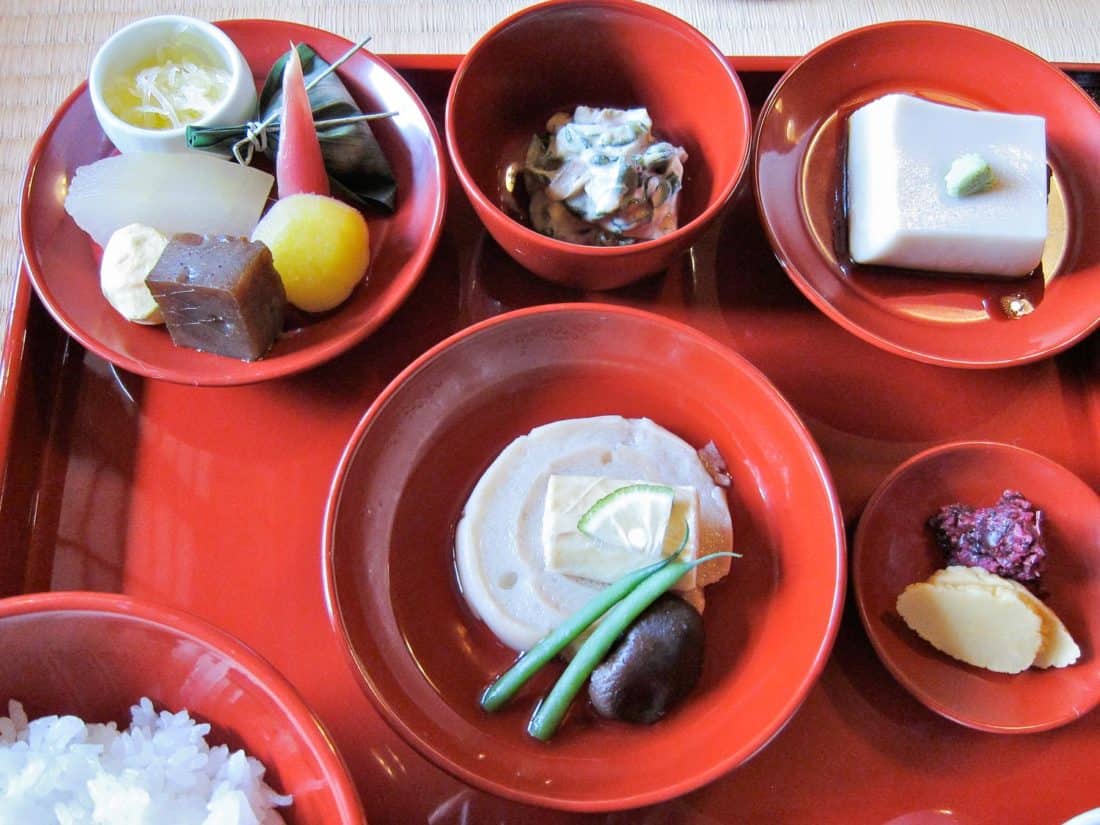
We ordered the cheapest lunch set (3800 yen / $24) and were served multiple small dishes on a red lacquer tray.
We couldn’t identify much of what we were eating, but that’s part of the culinary adventure and is the closest vegetarians can come to kaiseki (Japanese fine dining).
We later learned that the mysterious jelly-like cubes were konnyaku, known in English as Devil’s Tongue, which is made from the root of the tuberous plant konjac.
Other dishes included goma dofu (sesame tofu), yuba (sheets of soy milk skin), nasu dengaku (eggplant grilled with miso), nama-fu (raw wheat gluten), pickles, mushroom and cucumber salad in a sesame sauce, and pumpkin soup.
The food ranged from exquisite to odd and we loved the opportunity to try random things knowing that it was all meat-free, something we don’t often get to do.
Be sure to make a reservation on their website—ideally at least a few weeks in advance as they do book up (we booked two months in advance for peak autumn dates in November).
Note that you must also pay the 500 yen temple entrance fee (but it’s well worth visiting).
Location: Inside Tenryu-ji temple, Arashiyama.
Hours: Open from 11 am – 2 pm. Closed Thursday.
Credit cards accepted: Yes.
Website: Shigetsu
Visiting in November? See our guide to the best places to see autumn leaves in Kyoto.
6) Hobodo Cafe (TOP PICK)
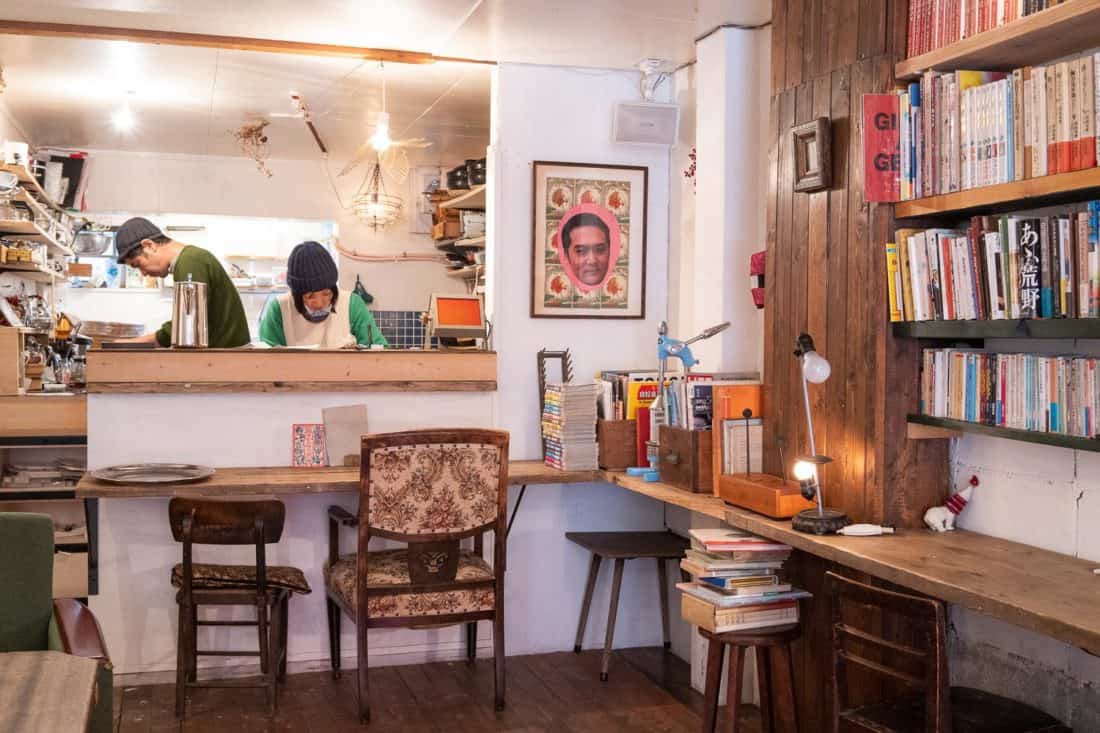
This cute Kyoto vegan cafe has a relaxed, vintage vibe with mismatched furniture and shelves of books.
It’s in a quiet, off-the-beaten-track residential neighbourhood, but it’s only a 15-minute walk from Gion and 20 minutes from Nanzenji. It’s worth a detour.
The friendly couple who run Hobodo Cafe speak some English and provide an English menu. They offer a set lunch to eat in or take away.
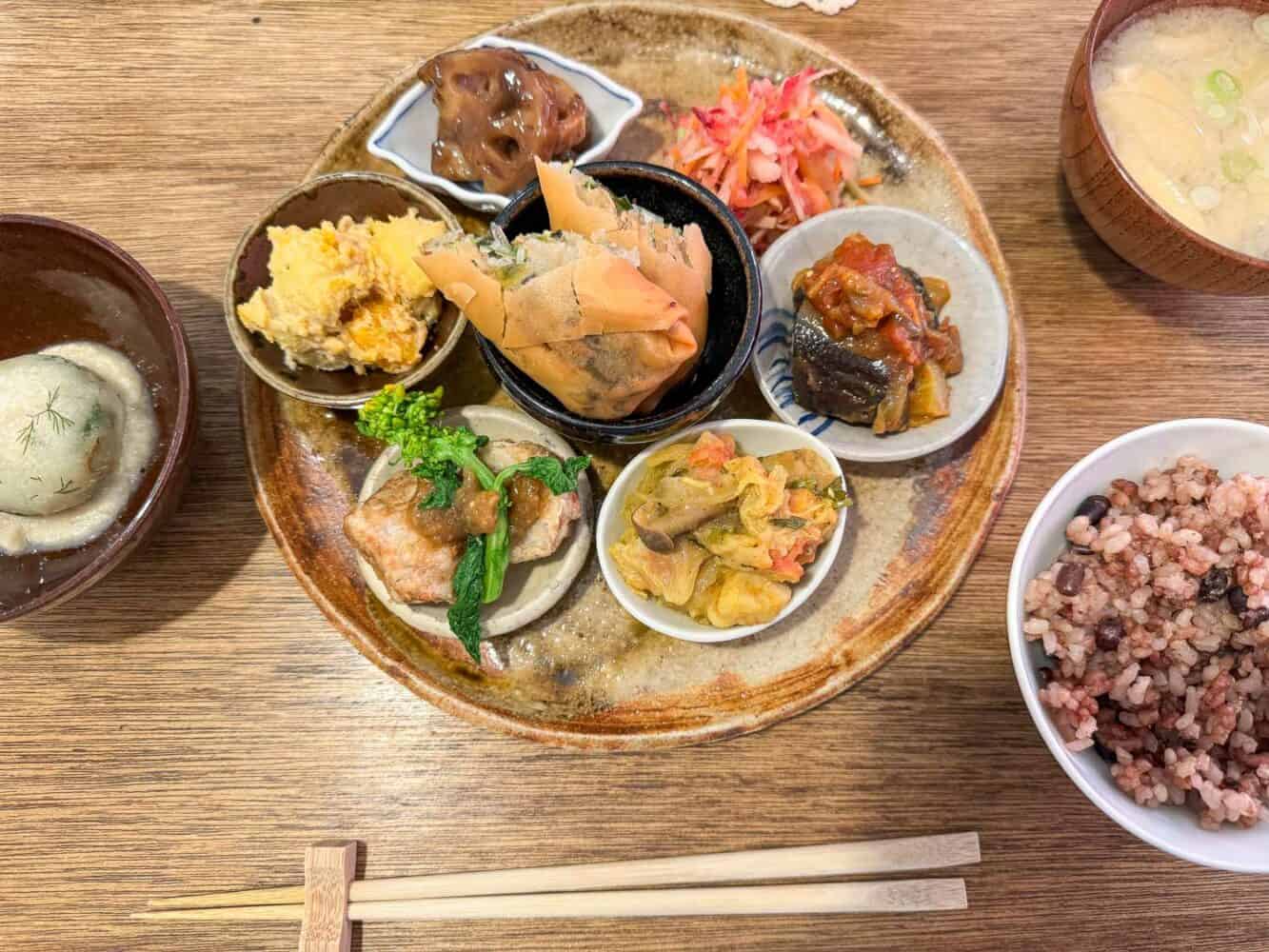
The set lunch (1600 yen/ $10) is one of our favourites in Kyoto. It includes brown rice, miso soup, and seven side dishes—ours included delicious dumplings, spring rolls, and various vegetables.
Location: 452 Shōōjichō, Sakyō-ku.
Hours: Open from Fri – Sun 11.30am – 5pm (last order 4pm) and closes on random days. Check Instagram for the month’s schedule (use Google Translate). They may run out of food later in the day.
Credit cards accepted: Yes.
Website: Facebook.
7) Mumokuteki Cafe
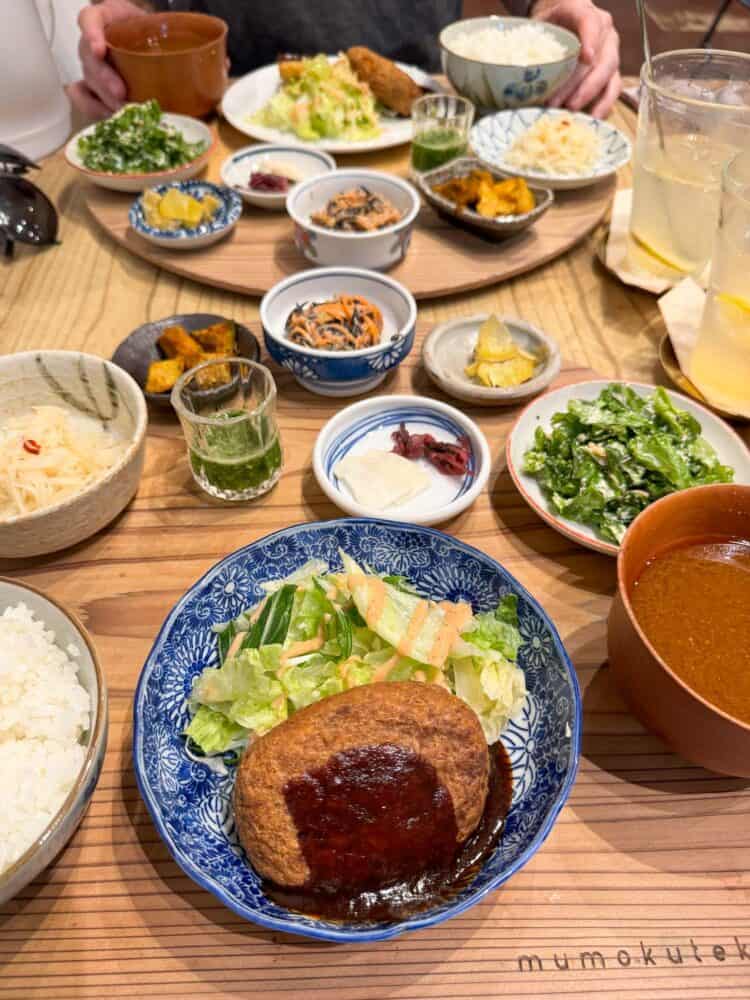
Mumokuteki is a vegan cafe a short walk from Nishiki Market (we can never get into Hale in the market so this is a great backup).
Their lunch gozen sets are excellent with a choice of mains (such as tofu hamburger or miso cutlet) and an array of vegetable sides plus the usual rice and miso soup.
This is also the only place I’ve seen that offers a vegan version of Japanese omurice (fried rice omelette). Their Mysterious Curry is also nice but the lunch sets are my pick.
While many Kyoto vegan restaurants are full of tourists, Mumokuteki has a mix of locals too. It’s quite spacious so we found it easier to get a table here than other spots (you can also book a table).
Location: 2F, 261 Shikibucho Nakagyoku. It’s on the second floor above a vintage store.
Hours: Open 11.30am – 5.30pm (6.30pm on weekends). Closed Wednesday.
Credit cards accepted: Yes.
Website: Mumokuteki.
8) Little Heaven
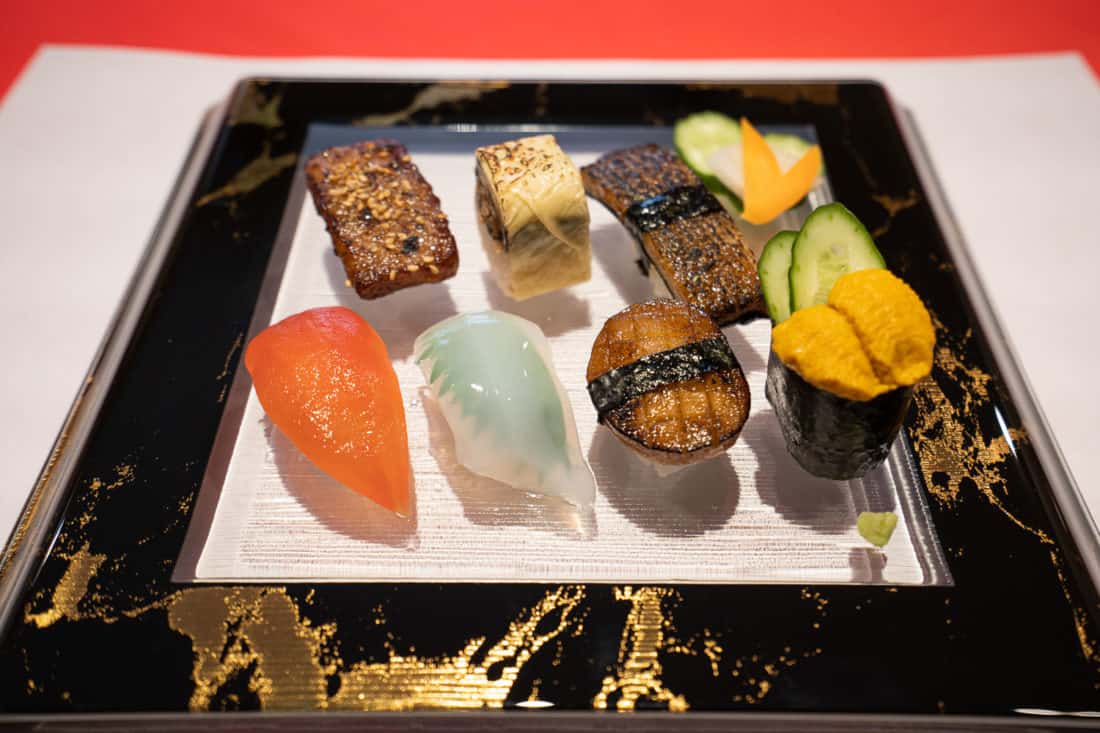
For high-end, creative vegan food in Kyoto, head to Little Heaven. They make a modern version of shojin ryori—there are many courses of beautifully presented, seasonal dishes but some westernised dishes are mixed with the traditional Japanese.
We were seated in a private room on a western-style table and chairs overlooking a small garden.
Highlights of our meal included yuba cooked in various ways, an impressive plate of sushi (replicating eel, tuna, and scallops), and an incredibly creamy matcha tofu cheesecake.
There were so many beautiful touches like vegetables shaped like butterflies.
It’s in the Arashiyama area but a few train stops from the main area.
You need to book at least three days in advance, but a few weeks is better. You can email [email protected] or book via their website.
Location: Sagano hirakichou 8–29 Ukyou-ku.
Hours: Open from 12pm – 7pm. Irregular opening days. Booking essential.
Credit cards accepted: Yes.
Website: Little Heaven
9) Padma
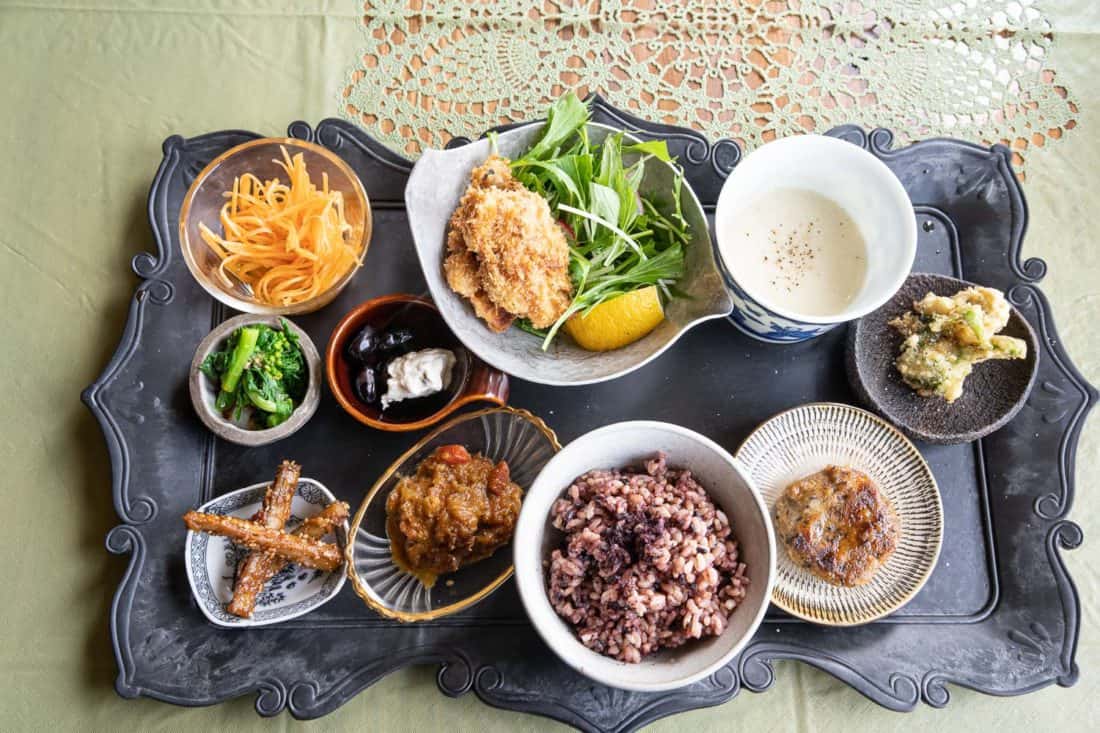
This Kyoto vegan restaurant has eclectic decor, large windows overlooking the Kamo river, and a small range of vegan products for sale.
At lunch Padma offers two set meals and a curry plate. I got the most expensive Peaceful lunch set which included rice, soup, and lots of small dishes.
It included a few soy meat dishes (deep fried and in curry) which I don’t usually like, but it was well prepared and the vegetables balanced it out.
Simon enjoyed the curry which was a generous amount of food but less variety than the lunch set.
Location: 2nd floor of Ebisu building (the door is to the left of Lawsons), Shimozutsumi-cho, 82.
Hours: Open from 12pm – 7pm. Closed Monday and Thursday.
Credit cards accepted: No.
Website: Happy Cow.
10) Veg Out
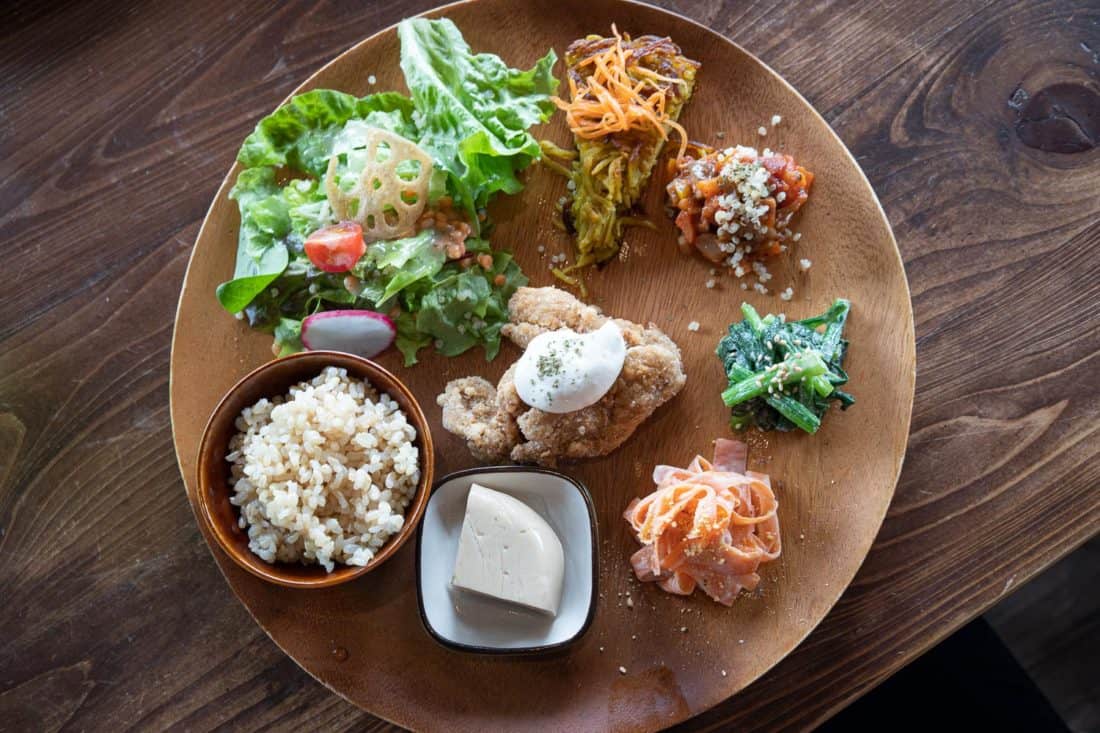
Veg Out is a Kyoto vegan cafe with a great location overlooking the Kamo River.
The plant-based menu includes Buddha bowls and taco rice, but our favourite dish is the Veg Out Plate, which changes daily and includes rice (or bread) and an array of vegetable dishes and salads. It’s perfect if you are craving veggies.
The coffee and kombucha are also delicious.
Location: 1F, 44 Inari-cho, Shimogyo-ku.
Hours: Open from 9am – 6pm (earlier if they run out). Closed Monday and some irregular days. Check their Instagram for the month’s schedule.
Credit cards accepted: Yes.
Website: Veg Out
11) Cafe Waka at Otera House ( 和香)
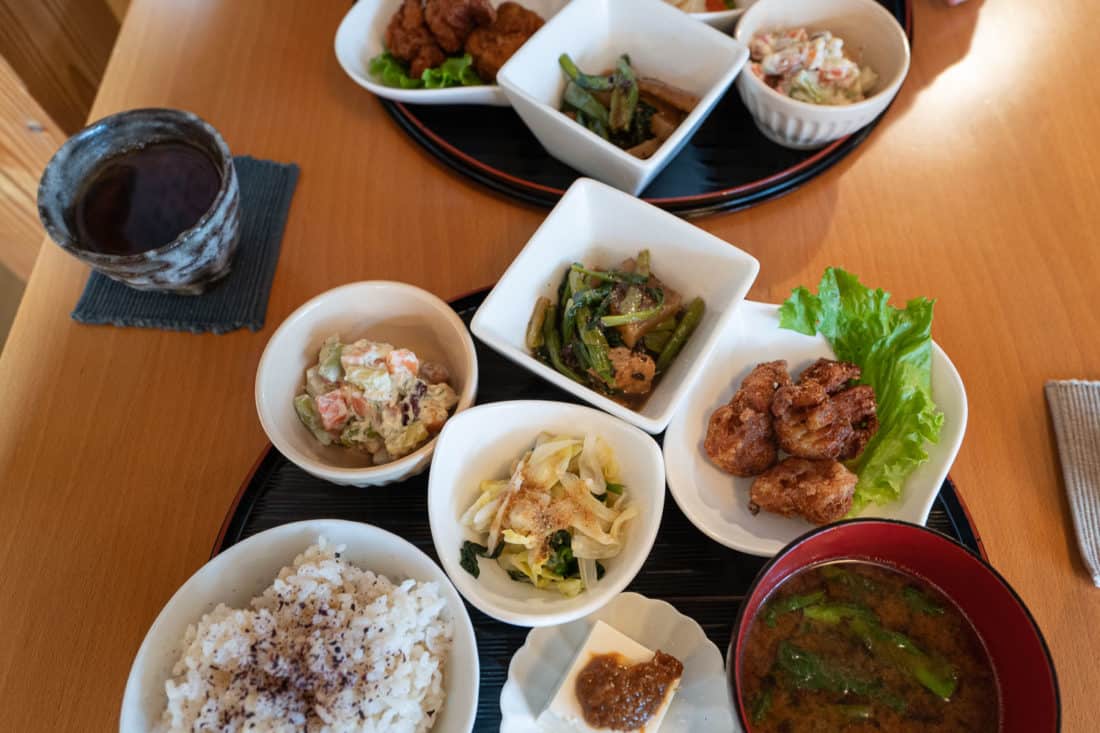
Shojin Cafe Waka is a Kyoto vegetarian restaurant that offers delicious Buddhist set lunches.
The location is a little off-the-beaten-track (we were the only tourists there), but it’s only a 15-minute walk across the river from Gion.
Our set lunch included rice, miso soup, pickles, deep-fried soy meatballs, leafy greens with tofu, cold silken tofu in miso sauce, and vegetables in mayonnaise.
All the dishes except the cakes are vegan, but it’s best to check.
It’s great value at 1000 yen ($6.40). Phone reservations are required for groups of more than three people.
Location: At Daizenin Temple. 397–9 Shinkaichō, Shimogyō-ku.
Hours: Open from 11.30 am – 3 pm on Wednesday, Thursday, Friday and Saturday. They can sell out earlier.
Credit cards accepted: No.
Website: Otera House website and Happy Cow listing.
12) AWOMB
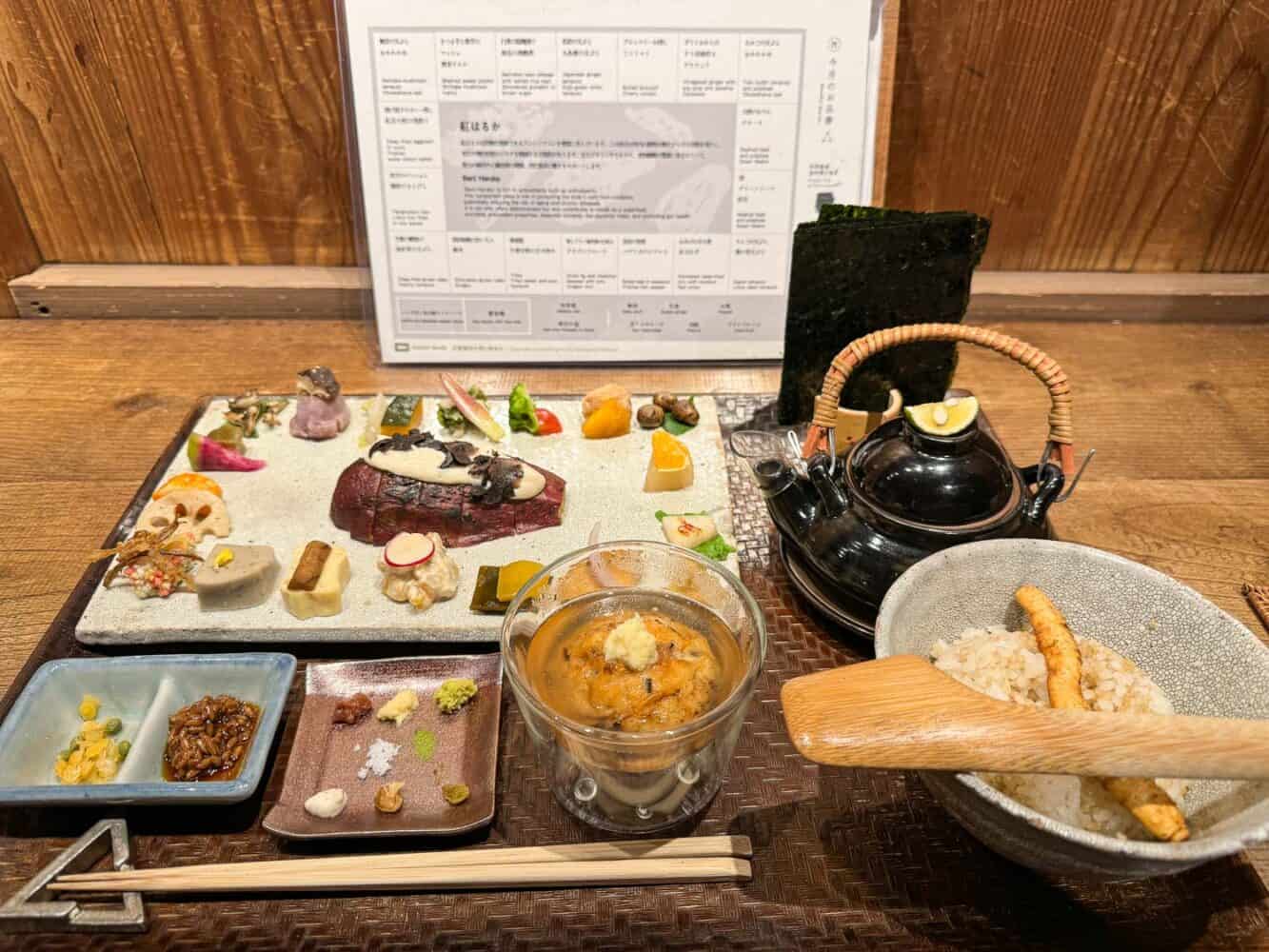
The Nishi-Kiyamachi branch of AWOMB offers something different—roll your own vegan sushi.
It’s all vegetarian and mostly vegan except for honey in some drinks and desserts.
Located in a traditional wooden house, you access it down a narrow garden pathway and take off your shoes but sit at tables. It’s one of the few vegan restaurants where we didn’t come across other foreigners.
The sushi platter features an array of seasonal vegetables, nori to wrap them in, wasabi and other flavourings, plus soup and rice. There’s a map (in English) so you can identify everything.
We paid extra for the premium menu, but I don’t think it was worth it for the few extras.
Flavours are quite subtle but we enjoyed having a lighter meal and the serene atmosphere.
Location: 405 Nanbacho. It’s across the river from Gion.
Hours: Open daily from 11.30am – 3pm and 5 – 7.30pm. Irregular closing days. Bookings highly recommended on Tablecheck.
Credit cards accepted: Yes.
Website: AWOMB.
13) Yoshuji
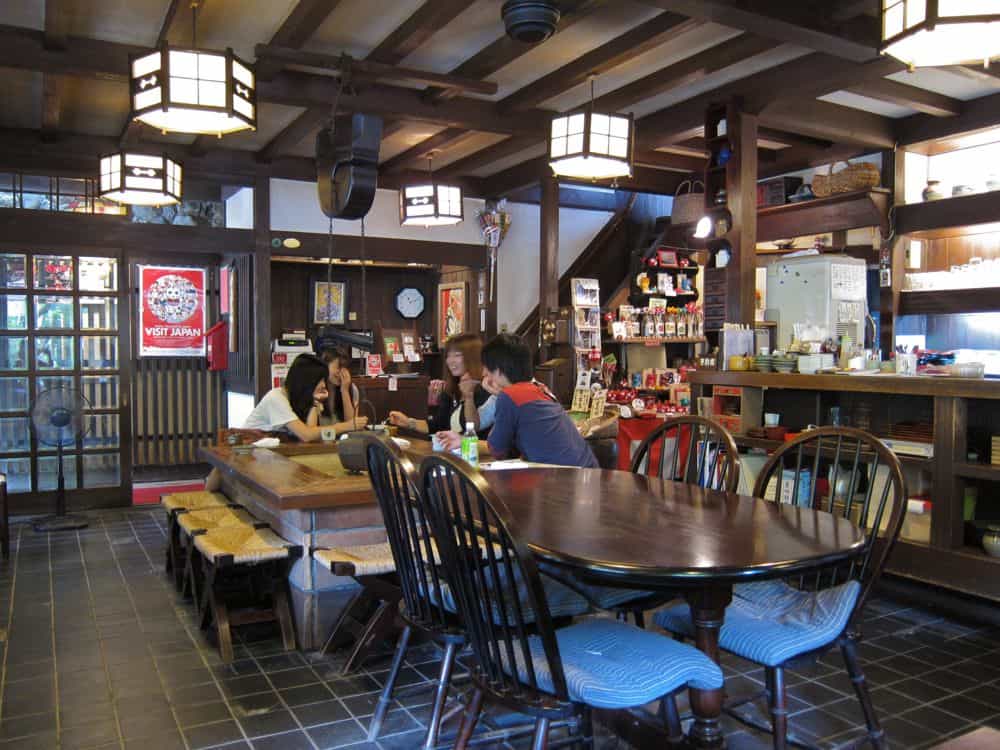
Yoshuji is a vegetarian restaurant in the village of Kurama in the mountains north of Kyoto. It’s mostly vegan except for milk for drinks and ice cream.
One of our favourite things to do in Kyoto is take the train to Kibune and hike through the forest to Kurama where you can visit the beautiful Kurama-dera temple and finish with lunch at Yoshuji.
The restaurant is in a cosy Japanese farmhouse with an irori (fire pit) in the centre. You can order a bowl of noodles or shojin ryori set lunches.
We chose the cheapest Hana set (2200 yen / $14), which came with rice, miso soup, pickles, enoki mushrooms, goma dofu (chilled sesame tofu), mashed tofu with wild greens, mashed yam with seaweed, and konnyaku served like sashimi with a dark miso sauce.
It was plenty of food for us, but on a cold day you might prefer the other sets for more hot dishes. The wonderfully smoky tea is included.
Yoshuji is halfway up the stairs leading to the entrance to Kurama-dera on the right hand side (or left as you come down as we did after hiking from Kibune). There is an English menu outside.
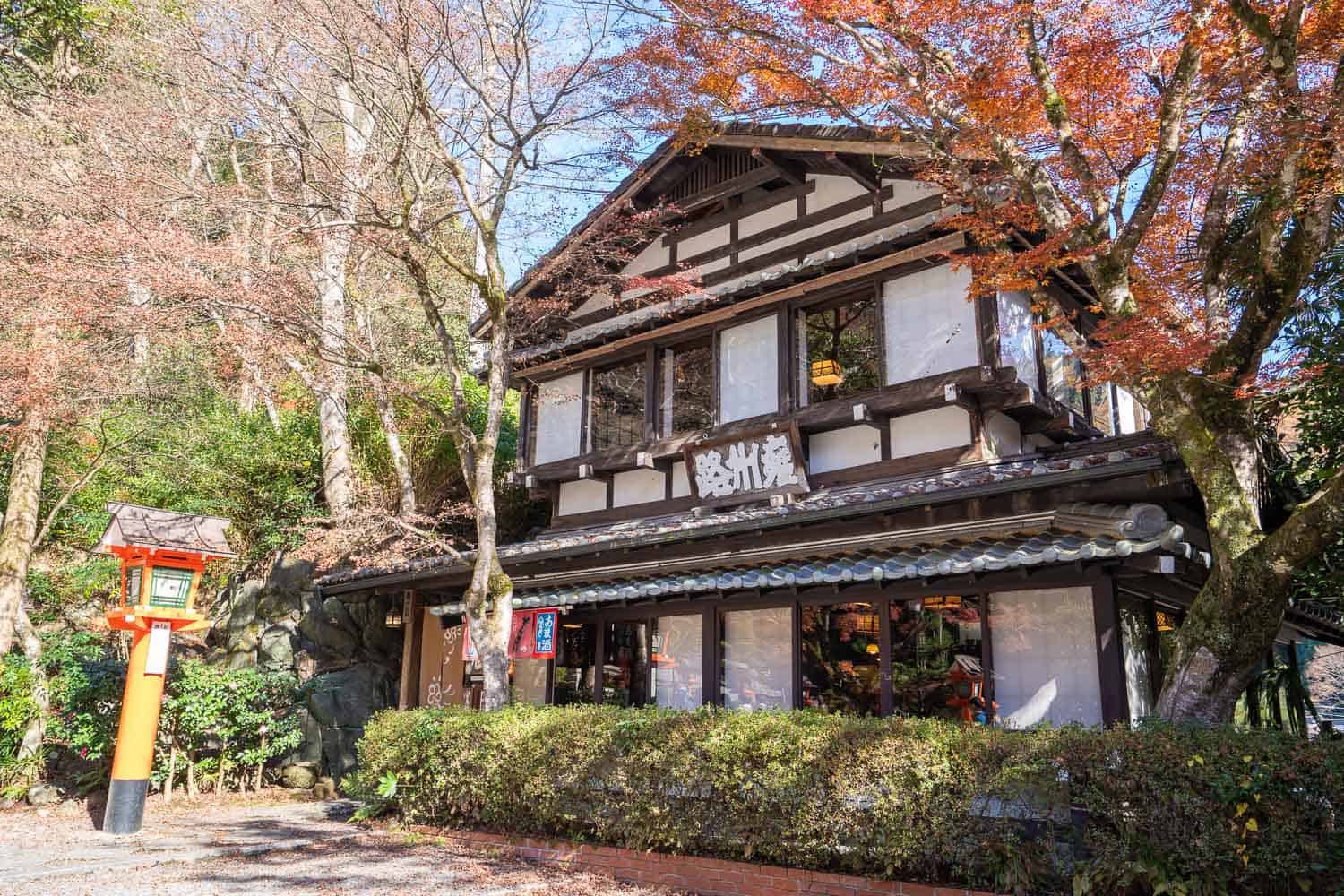
Location: 1074–2 Kuramahonmachi, Sakyō-ku. It’s a 3-minute walk from Kurama Station and a 25-minute walk downhill from Kurama-dera (or there’s a cable car).
Hours: Open from 10am – 6pm. Closed Tuesday.
Credit cards accepted: No.
Website: Yoshuji
14) Cafebar Mokumoku
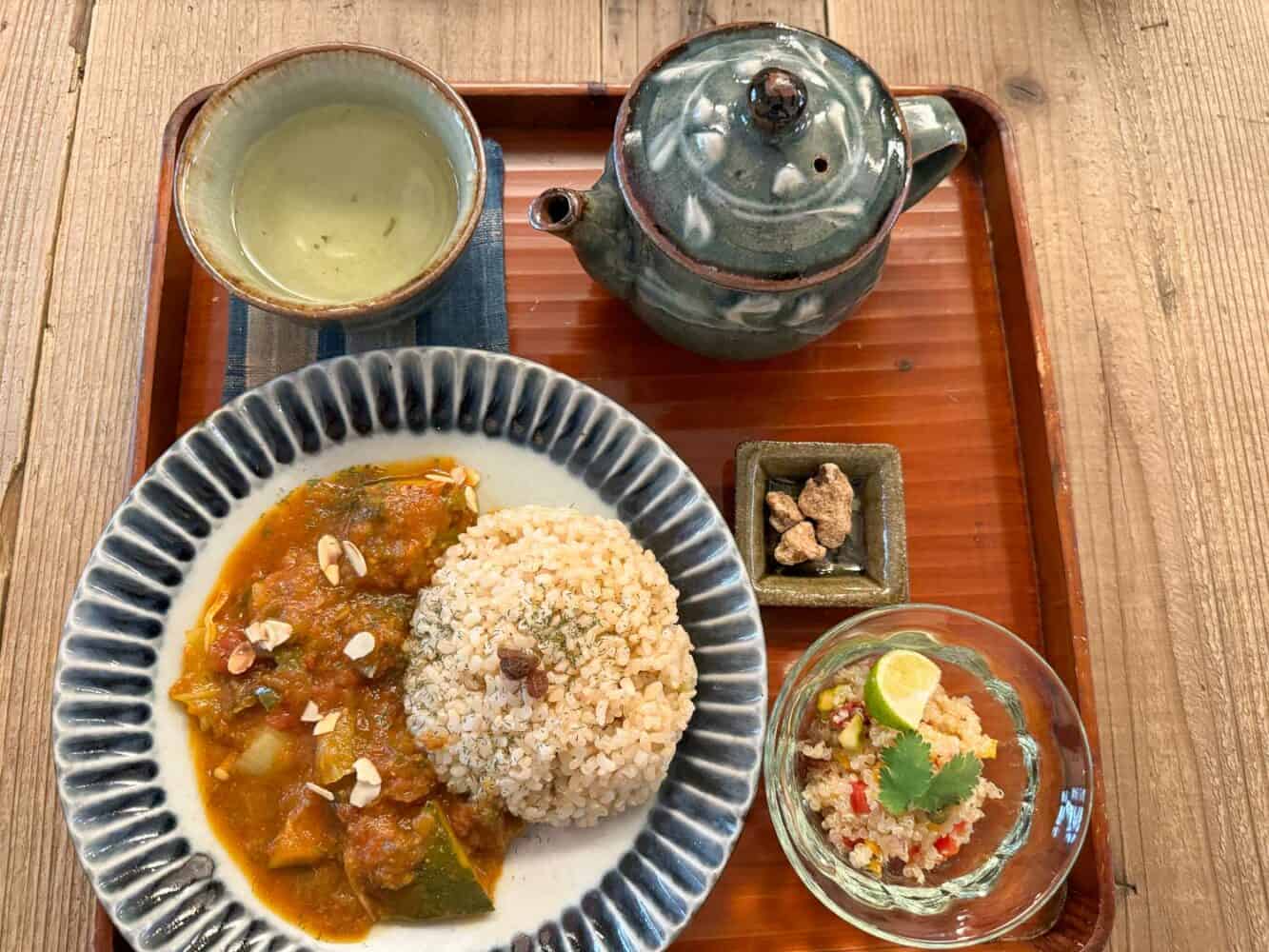
Mokumoku is a tiny vegetarian (mostly vegan) cafe within a shop that sells beautiful textiles and ceramics.
It’s a peaceful retreat on one of the most popular tourist streets in Kyoto leading to Yasaka Pagoda.
The menu is limited with a few vegan sweet treats plus one vegan lunch that changes regularly. When we visited it was a vegetable curry. Other times it’s soup or a more traditional Japanese set lunch.
If you are hungry while sightseeing in Gion, it’s worth popping in to see what they have, but the opening hours and what they have available can be unreliable.
Location: 87 Hoshinocho, Gion.
Hours: Open Tuesday – Sunday from 9am – 3pm. Closed Monday and some irregular days—check Instagram as it changes a lot.
Credit cards accepted: Yes.
Website: Mokumoku.
Vegetarian-Friendly Restaurants in Kyoto
Some of the best vegetarian and vegan food in Kyoto isn’t found in vegetarian restaurants. The restaurants below serve meat and fish, but they also cater for vegans.
They are good options for dinner as many Kyoto vegetarian restaurants only open for lunch. You can try classic Japanese dishes like udon, gyoza, and okonomiyaki in a typical setting.
For vegetarian sushi in Kyoto, we recommend these vegan restaurants (see above): Uzu (as a starter before your ramen), Little Heaven (high end tasting menu) and AWOMB (create your own sushi rolls).
15) Mimikou for Udon (TOP PICK)
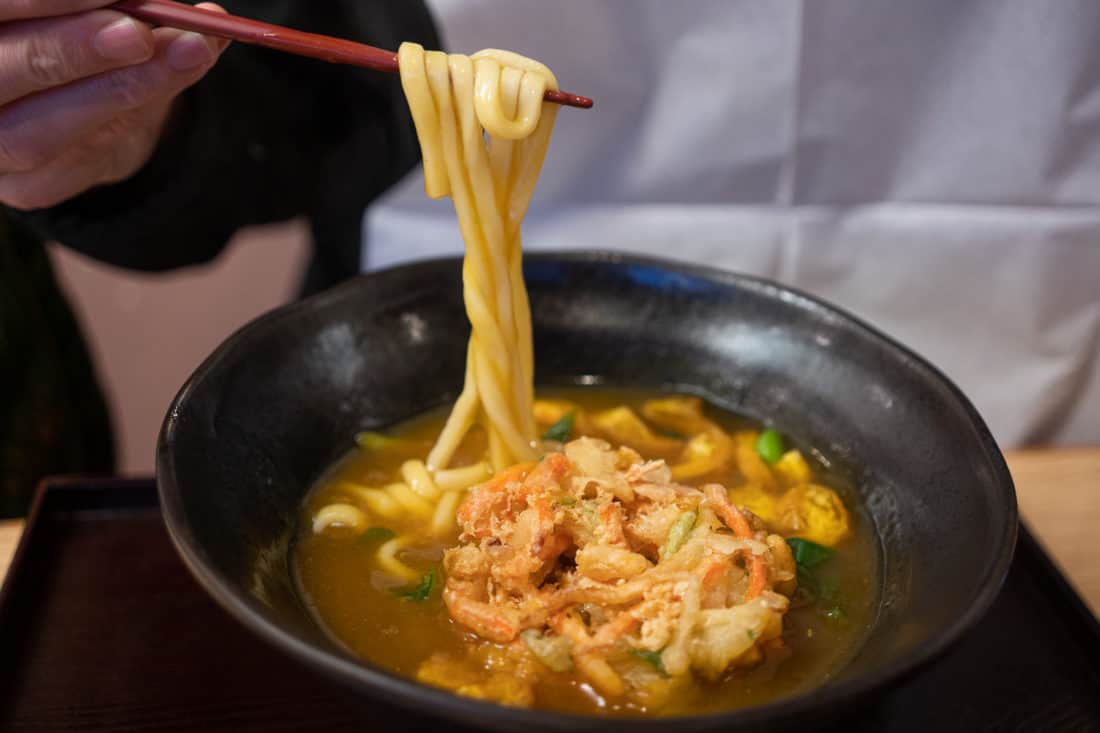
We are regulars at Mimikou when we visit Kyoto. This traditional udon (wheat flour noodle) restaurant is located near Yasaka Shrine and is popular with tourists.
Two pages of the English menu are dedicated to vegetarian dishes including ramen and curry donburi (rice bowls), but best of all is the curry udon.
The udon can be topped with kitsune (fried tofu), vegetable tempura, vegetables, and/or soy nuggets.
You can choose your type of udon (we liked the regular noodles which are quite thick), spice level (medium was ideal for us), and any extra toppings.
The vegetarian menu is vegan except for the option to add egg. They confirm that they do not use dashi in the soup.
It can be messy so use the paper bib the staff bring you!
Location: 528–6 Gionmachi Minamigawa.
Hours: Open daily from 11.30am – 3pm and 5-8pm.
Credit cards accepted: Technically yes, but their machine was broken every time we visited.
Website: Mimikou
16) ChaoChao for Gyoza
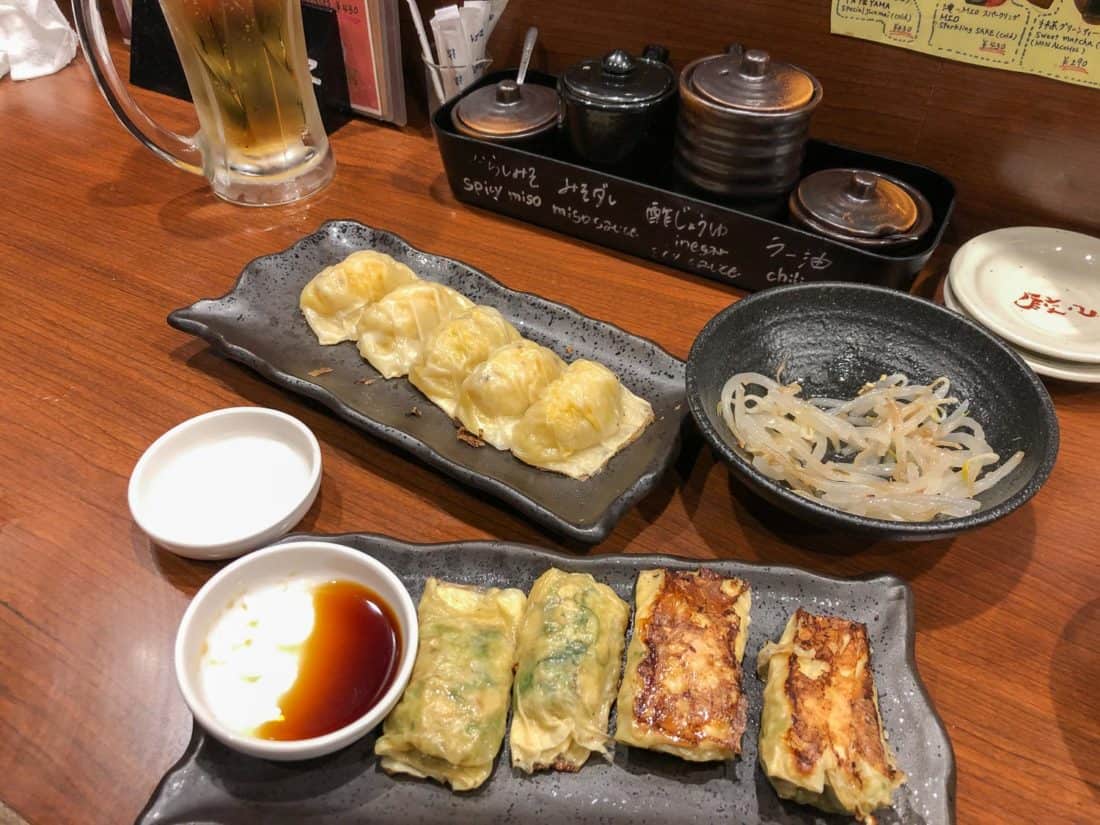
This gyoza bar is a fun place for a drink and a quick, inexpensive meal. The staff are friendly and speak some English.
The Shijo-Kawaramachi branch of Gyoza ChaoChao has a vegetarian menu in English with five types of vegetarian gyoza plus side dishes like bean sprout salad and deep fried tofu.
Vegan options are marked and include yuba gyoza and vegetable gyoza.
All the gyoza we tried were delicious including mashed potato, yuba, mushroom risotto with cheese, and shibazuke (soy pulp and pickles).
Unfortunately, since our first visit, Gyoza ChaoChao has become very popular with long queues outside (even at 5.30pm on a weekday). Although we enjoy the food, I don’t think it’s worth an hour-long wait. Try going at 4pm to beat the rush.
Location: Shijo-Kawaramachi branch at 312-1 Junpucho. It’s close to Kyoto Kawaramachi Station in Kyoto’s main shopping area.
Hours: Open from 4pm – 11pm every day (from 2pm on weekends).
Credit cards accepted: Yes.
Website: Gyoza ChaoChao and Happy Cow listing.
17) Tousuiro for Tofu
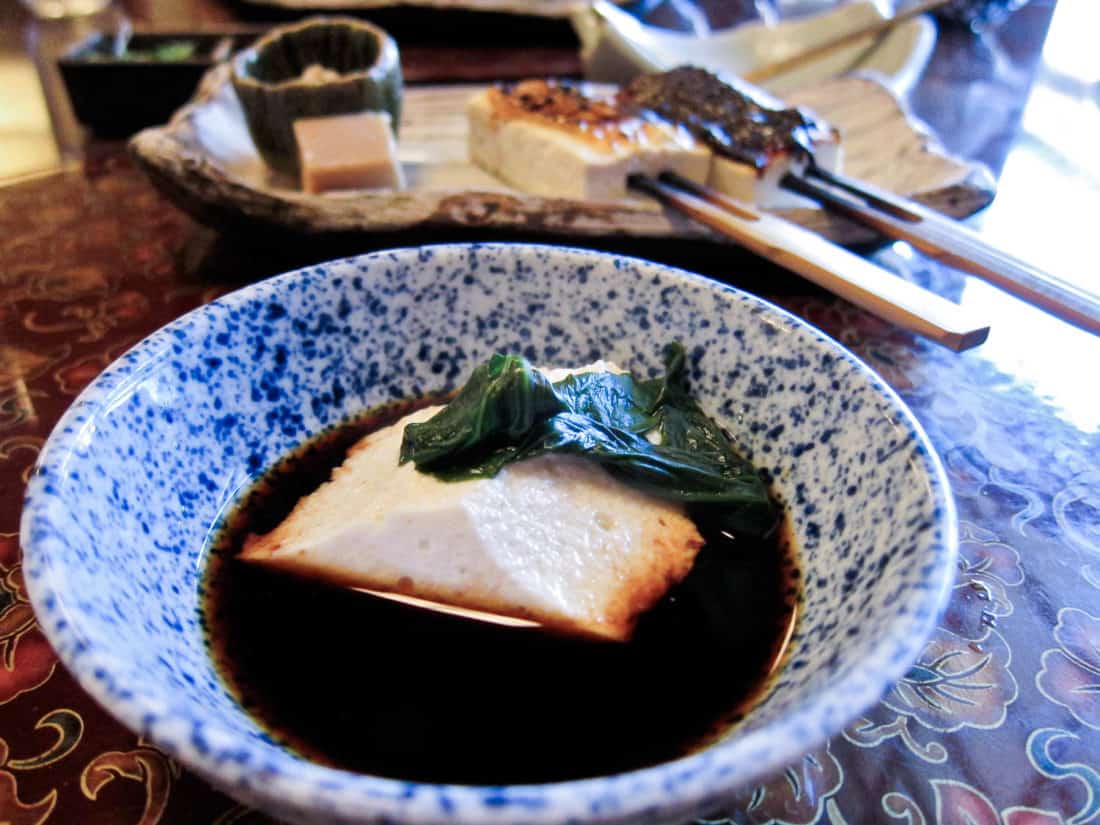
Kyoto is famous for its tofu and there are a number of restaurants that specialise in it, but they usually use dashi.
The Gion branch of Tousuiro offers a vegan set menu as well as a vegan and gluten-free kaiseki set menu.
It’s not cheap (from 10,000 yen/ $64), but it is an unusual experience and the setting is traditional in a 130-year-old merchant house.
You’ll experience tofu in all its forms including goma dofu (sesame tofu), yuba (soy milk skin), yudofu (a simmering pot of tofu and greens), and grilled miso-glazed dengaku tofu. We did get a little tofued out but are glad we tried it.
You no longer need to book the vegan menu in advance, but the gluten-free version does require a reservation.
As it’s a popular place, it’s highly recommended to reserve a table anyway. If you make a reservation by email, make sure to email at least three days in advance.
Location: 38–1, Bisyamonten-Cho. A 15-minute walk from Keihan “Gion Shijo” station.
Hours: Open daily from 11.30am – 3pm and 5pm – 10pm (9.30pm on Sundays).
Credit cards accepted: Yes.
Website: Tousuiro
18) Kamehameha for Okonomiyaki
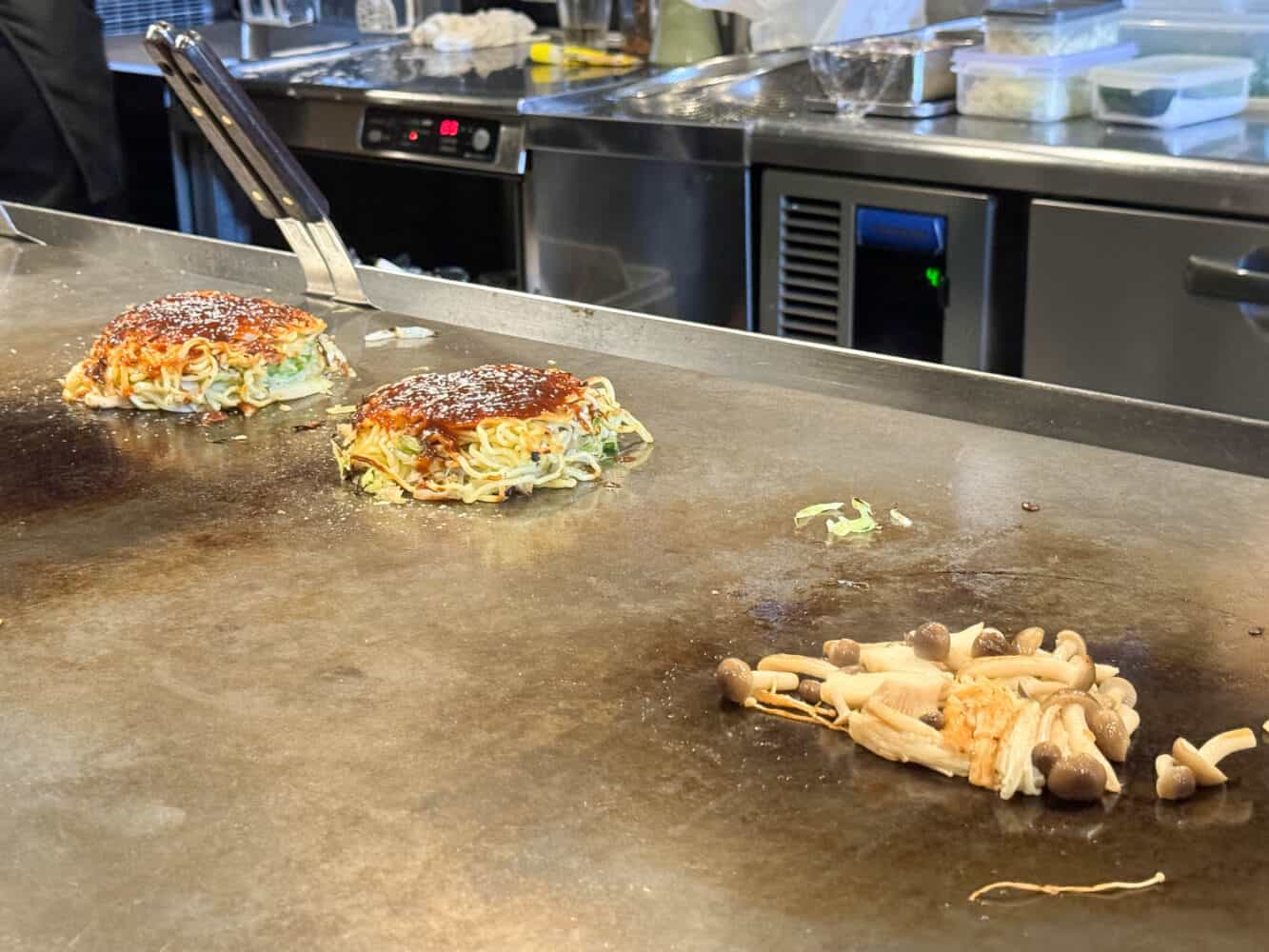
Kamehameha is a tiny teppanyaki place with just eight seats at the counter. It’s known for its Hiroshima-style okonomiyaki and they can do a vegan version.
It’s hot and cramped, but it’s fun to see the chef cook on the griddle in front of you. This is not the place for you if the sight of meat or seafood cooking bothers you, but they do wipe the surface between dishes.
We got the vegan set, which included a few tasty starters and a smaller size (but still plenty) mushroom okonomiyaki. Hiroshima-style means the cabbage batter includes noodles and is layered rather than mixed.
It’s very popular (countless people were turned away on our visit) so do book in advance. You can use the form on their website—bookings open in the middle of the month for the following month.
Location: 274-12 Enpukujimaecho. It’s down an alleyway not far from Nishiki Market.
Hours: Open from 4-10pm. Closed Thursday and Sunday.
Credit cards accepted: Yes.
Website: Kamehameha.
19) Teppan Tavern Tenamonya for Okonomiyaki (with Meat Eaters)
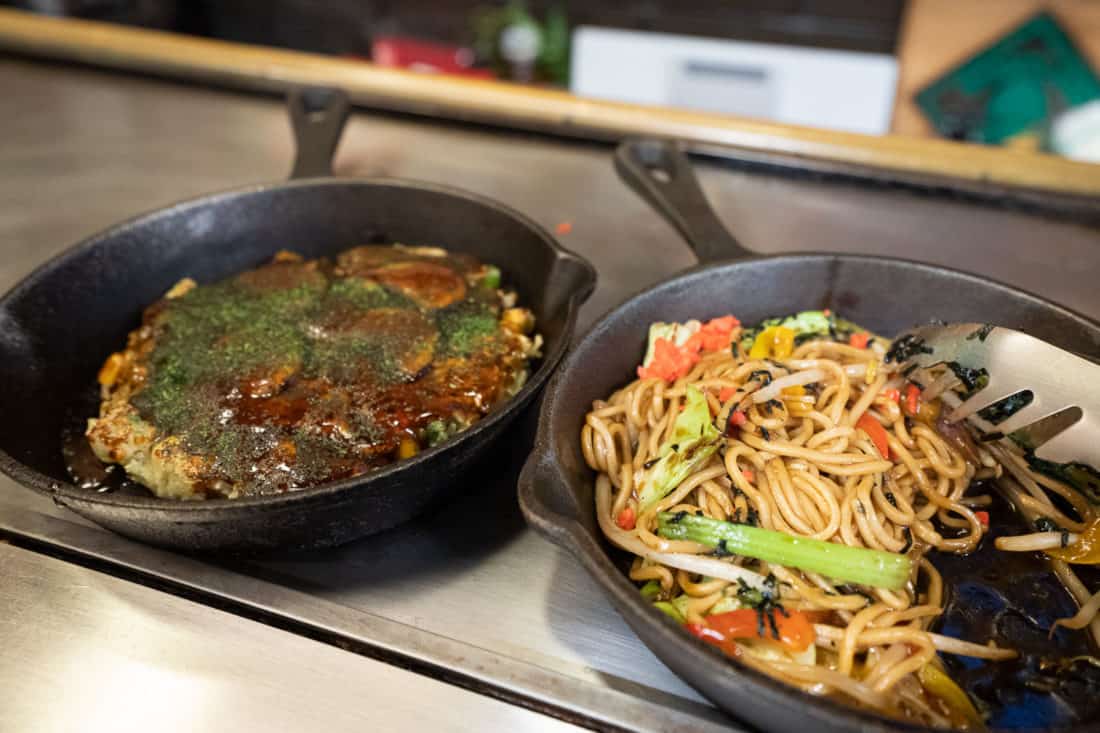
Teppan Tavern Tenamonya is another place to avoid if you don’t want meat cooked next to you, but it’s a good choice if you are travelling with a meat eater who wants to try the famous wagyu beef.
It’s a small izakaya (pub) with counter seating and a grill in front of you to keep the food hot.
Most of the guests are foreigners these days as it’s close to Yasaka shrine, is ranked highly on Tripadvisor, has an English menu, and is run by a friendly couple.
It’s so popular that booking up to two weeks in advance is essential (you can email but don’t email more than 15 days ahead). They can’t accommodate groups bigger than four people. Check out their website for all the details.
Despite the meat focus, they offer a number of tasty vegetarian dishes including okonomiyaki (the Hokkaido version was good), yasai soba (fried noodles with vegetables), and fried potato with cheese.
But they don’t encourage groups that are all vegetarian any longer.
Location: B1F, 537–2 Gionmachi Minamigawa.
Hours: Open 5pm – 10pm. Closed Wednesday and Thursday.
Credit cards accepted: Yes.
Website: Teppan Tavern Tenamonya
20) CoCo Icibanya for Japanese Curry
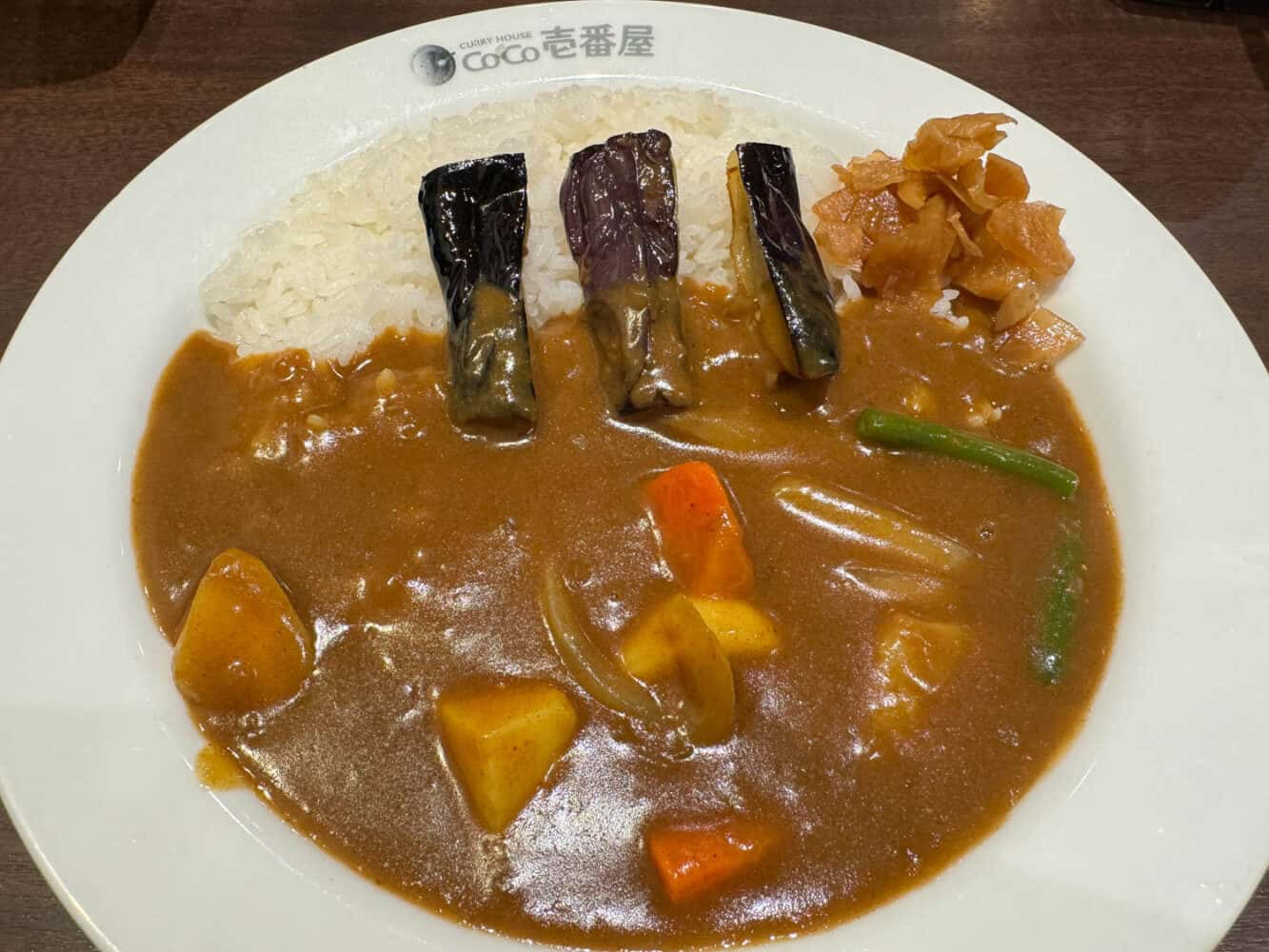
Looking for the nearest CoCo Ichibanya is one of the easiest ways to find a vegetarian meal in Japan.
This popular curry chain now offers a vegan curry (described as vegetarian) at all its branches. They also have an English menu, which is helpful to explain the ordering process.
You choose your curry sauce (vegetarian), toppings (we usually get vegetables and eggplant), spice level (2 or 3 is pretty spicy), and size of rice portion. It’s tasty, filling, inexpensive, and quick.
The pickled vegetables on the table are vegan. If you are self-catering, you can buy vegan curry packets to heat up at home.
We went to CoCo Ichibanya Keihan Shichijo, but there are many branches (search on Google Maps).
Location: Various branches.
Hours: Open from 11am – 11pm. There may be some variation between branches.
Credit cards accepted: Yes.
Website: CoCo Ichibanya
International Vegan and Vegetarian Food in Kyoto
My listings above focused on Japanese vegetarian food as it’s so good, but on longer trips, we do want something different occasionally.
Here are our favourite international restaurants for vegan food in Kyoto.
- Zirael – This Gion vegan restaurant focuses on salad made from local veggies served with a choice of mains such as dumplings or fried soy meat.
- Que Pasa – Surprisingly delicious burritos with vegetarian and vegan options. It’s run by Japanese guys who lived in California so they know what they’re doing. There are two branches (see map below).
- Waco Crepes – On a quiet, pretty street in Gion, this small cafe has sweet and savoury gluten-free crepes with plenty of vegan options. For lunch, we like salsa and cheese, which comes stuffed with salad.
- Ain Soph – This popular Kyoto vegan restaurant isn’t our favourite, but if you’re craving a veggie burger, they are pretty good.
- Vegginy – Another vegan cafe with huge veggie burgers and a few other dishes.
- Kyoto Beer Lab – Cool brewpub on our favourite canal street. You can get a tasting flight of beers with snacks like nuts and pickles. Vegan options are marked, but it’s not the place for a filling meal.
For vegetarians in Kyoto we also recommend:
- Monk – The tasting menu of roast vegetables and wood-fired pizza was one of our favourite meals in Kyoto. They can cater for vegetarians but not vegans. It’s extremely difficult to get a table, though. You need to book on Tablecheck at exactly 12pm JST two months in advance. It sells out in seconds so be prepared (and practice). Our Monk Kyoto restaurant review has step by step instructions on how to secure a reservation.
There are several excellent places for authentic Neapolitan-style pizza in Kyoto. Vegans will be limited to pizzas without cheese though.
- Pizzeria Da Naghino – Delicious pizza about a 15-minute walk from Gion.
- Pizzeria Napoletana Da Yuki – Bookings are highly recommended. It’s a bit out the way (a 15-minute walk from both Gion and Nanzenji) but we liked that the other diners were all Japanese.
- Goichi Pizza – Popular with tourists, this place is closer to downtown. We liked their green salad as well as the pizzas. Go early or book.

For Something Different: You can also request vegan snacks to accompany the cocktail tasting menu at Nokishita711. These are not your typical sweet cocktails—they are low alcohol and described as liquid cuisine with flavours extracted from plants (as well as meat and fish for the non-vegan option). For the adventurous only! Reservations are essential as they only seat four people.
Vegetarian Cooking Class in Kyoto
Taking a cooking class is one of the best Kyoto activities and a great way to learn more about Japanese cuisine.
The class we did is no longer available, but another option is this Afternoon Japanese Izakaya Cooking Class with Cooking Sun.
They can cater to vegetarians and you learn to make 5-6 home-style dishes. Just be aware of the likelihood that others in the class will be cooking non-vegetarian food. If this bothers you, you can pay for a private class.
They also offer a Nishiki Market tour followed by a donburi (rice bowl) cooking class. Vegetarians can make tempura.
Vegetarian Kyoto Map
Our Kyoto vegetarian map lists all the restaurants mentioned above.
The vegetarian and vegan restaurants in Kyoto are marked in green, veggie-friendly traditional restaurants in blue, and international restaurants in yellow.
Summary
I hope you enjoy eating your way around Kyoto as a vegetarian as much as we did! There are many more vegetarian and vegan restaurants that we didn’t have time to try. Leave a comment below if you have any more recommendations.
More Japan Posts
Our Vegetarian Japan Guides
- Vegetarian Survival Guide to Japan
- The Best Vegan and Vegetarian Restaurants in Tokyo
- The Best Osaka Vegetarian Restaurants
Japan Tips
- 26 Unforgettable Things to Do in Kyoto, Japan
- Where to Stay in Kyoto: Recommended Hotels and Areas
- 2 Week Japan Itinerary
- 16 Unmissable Places to Visit in Japan
- Planning a Trip to Japan: Dos and Don’ts
Enjoyed this post? Pin it for later!


I’ve loved all of your posts Erin and you have provided some amazing tips. We visit Japan in April 2025 for 3 weeks and I’ve used your guides to plan the trip so a big thank you as I know it must’ve taken you hours and hours to create and I can’t tell you how much I have appreciated your advice. One issue we’re struggling with is that we want to eat at these vegetarian places but most of them use mirin/sake/alcohol which we can’t consume. I’ve emailed/phoned a few restaurants and they say they can’t remove the mirin. I feel we’re going to struggle with finding veg places that do not use mirin/sake. I wondered if you knew of any places?
Thanks for your kind words Sam and I’m glad you found the posts useful! That is a tricky problem, and honestly, not one we’ve had to think about.
Perhaps look for halal restaurants that have vegetarian options. For example, Matsuri in Osaka was great (see our Osaka vegetarian guide). I can’t think of any others but if you do some searching, hopefully you’ll find some options. Good luck! Erin
Thanks a lot for very detail posts for vegetarian dining in Japan <3 . Honestly your guides saved me.
Aw, I’m so glad they helped!
Please try this veg place – heavenly food. Very very nice set lunches and dinner.
It is called Izusen Daijiinten, next to public parking lot and besides the temple.
Website: kyoto-izusen.com
〒603-8231
京都府京都市北区
紫野大徳寺町4
大慈院内
Thanks! We’re hoping to get there!
As I was researching your list I discovered Pettiroso has a sign discouraging non Japanese speakers from eating there and others commented they were actually turned away. It’s certainly their choice, but you might add that to the description.
My husband and I went to Mimikou on your recommendation tonight for dinner and it was a win! We both had a curry udon meal (mine had eggplant and a soy protein) and they were both excellent! That, plus the fast service and helpful waiters that put up with us westerners was the best! Thank you for the recommendation!
Yay! Glad you enjoyed it Meg!
I love the breakdown of the different foods. I recently ate there and was wondering what some of these delicious things were. I was particularly confused by the eggplant, I thought it was pumpkin or something. Thank you.
Mikoan closed due to fire in August per site. I am visiting Kyoto right now and had SO looked forward to eating there. :-(((
However, Miyako does now serve twice a week at Jazzmass K’s Case;
Oh no, that’s such a shame. Thanks for the info.
There is so much great food in Kyoto. I love the regional specific food especially. I’ve never seen so much matcha inspired food before. I’m also a big fan of the focus on seasonality and freshness.
Since I am going to Japan soon, I wonder if a place like this could omit the wheat ingredients for someone who is intolerant to the gluten. I am training myself to be able to ask this correctly “komugi arerugi”, but the food at this place looks really interesting. I don’t mind eating vegetarian. Besides the fu, which I cannot have, the rest looks quite nice!
Thank you for the wonderful details. I am a student from India and here in japan for 6 weeks. I am a vegetarian and its difficult to get food here which is completely veg. Your website helped a lot. Luckily, the people here where I am studying helped me find vegetarian restaurants. The food is amazing and mostly consists of vegetables
Can you please create a list for others Vegans?
The Mikoan seem like was close for business recently. Thanks for sharing.
Hi there! thank you for this articles, these photos are amazing, im planning to go to japan to work as a chef in a vegetarian restaurant, Mikoan seems to be an amazing place, I serched on the web page but i coul not find the email adress, did you save any email adress of those restaurants?
Best regards
I’m afraid I don’t have the email.
I was wondering do we need to reserve place for the meal at the temple in advance or can we just drop in at lunch time? What were the lunch timings? Thanks!
We just dropped in, it was pretty empty. I’m afraid I don’t remember the opening hours.
Ohhhh god. Miko-an is, I swear, my favourite restaurant in Japan. We’ve been dreaming about returning to this place for years. Thanks for the photos – took me back.
Hi there,
Thanks for writing a such a thorough article.
I will be visiting Kyoto this month and choose to stay near Kyoto Station as it will be convenient to move around.
I searched but couldn’t find a proper vegetarian restaurant near Kyoto station.
Could you guide me on this.
Thanks in advance.
These and the ones in Part 2 are the only vegetarian restaurants we visited. Mikoan isn’t too far from the train station though.
I’m itching to go to Japan but I’m a strict vegan and the food issue has been worrying me, so this post is SO helpful. Cheers!
Glad it helped. Kyoto is easy for vegans if you plan which restaurants to go to in advance. Enjoy!
We just dropped by Mikoan this evening after having read your write-up around a week ago. What a place! Totally unique and a wonderful, cosy, atmosphere! We loved the semi-decorative clutter, soft jazz, and the small shrine with bottles of alcohol on either side up behind the counter (plus the Guinness pump draped in Buddha beads)! The owner, it turns out, is a jazz pianist, and she kindly gave us a demonstration of her impressive talent on the piano! She’d encouraged us to enjoy the instruments at our leisure, and told us she likes people to jam there if they want to. She also seems to be familiar with the sanshin, an Okinawan string instrument which she pulled out to show us! Such a wonderful lady. Thanks for the write up – doubt we’d ever have visited if we hadn’t seen your article, and now we can’t wait to go back :) great food too. A 5 star place!
So glad you made it there and enjoyed it Chris! It is a wonderful unique place. Shame we missed the owner’s piano skills and Simon would have loved to have a go himself. Next time!
Thanks for this. I’d love to sample the laid-back ambiance at Mikoan and all the amazing dishes at Shigetsu. I’d especially like to know how to make the Goma Dofu. Good luck with your continued travels!
We loved the food in Kyoto and hope you enjoy it too!
Eggplant?
Yeah, I know! As international travellers rather than resident Brits we’ve picked that up, as no one except for us and the French use the word aubergine :)
Also know as Brinjal
I love this post! As a vegetarian and foodie, it’s really great to see such a variety of vegetarian food on offer in Kyoto. It’s somewhere I had never considered visiting before but it looks like it’s worth it just for the culinary adventure!
Keep up the good work!
Robyn x
Glad you enjoyed the post Robyn. Japan as a whole isn’t the easiest country for vegetarians but Kyoto has some amazing vegetarian restaurants. Every meal we ate was different but always beautiful and interesting. It’s definitely worth a visit and luckily it’s a wonderful city anyway.