This page contains affiliate links. Please read our disclosure for more info.
It took eight modes of transport to get to Koya-san from Kyoto: metro, bullet train, metro, train, bus, train, cable car, bus. In any other country the journey would have taken all day, but despite a damaged train track from the recent typhoon, in Japan it took less than four hours and the transfers were seamless.
We visited Koya-san, the respectful name given to Mount Koya, to experience traditional Japan. The secluded temple town is located high up in the forest-covered mountains of Kansai and was founded 1200 years ago by Kobo Daishi to spread his teachings about Shingon Buddhism.
One temple has grown to over one hundred and the town is now an important Buddhist centre. It is also one of the best places to stay in shukubo, traditional temple lodging to get a taste of life as a monk including sampling shojin ryori, vegetarian monk’s cuisine and rising early to participate in the daily chanting and meditation ceremony.
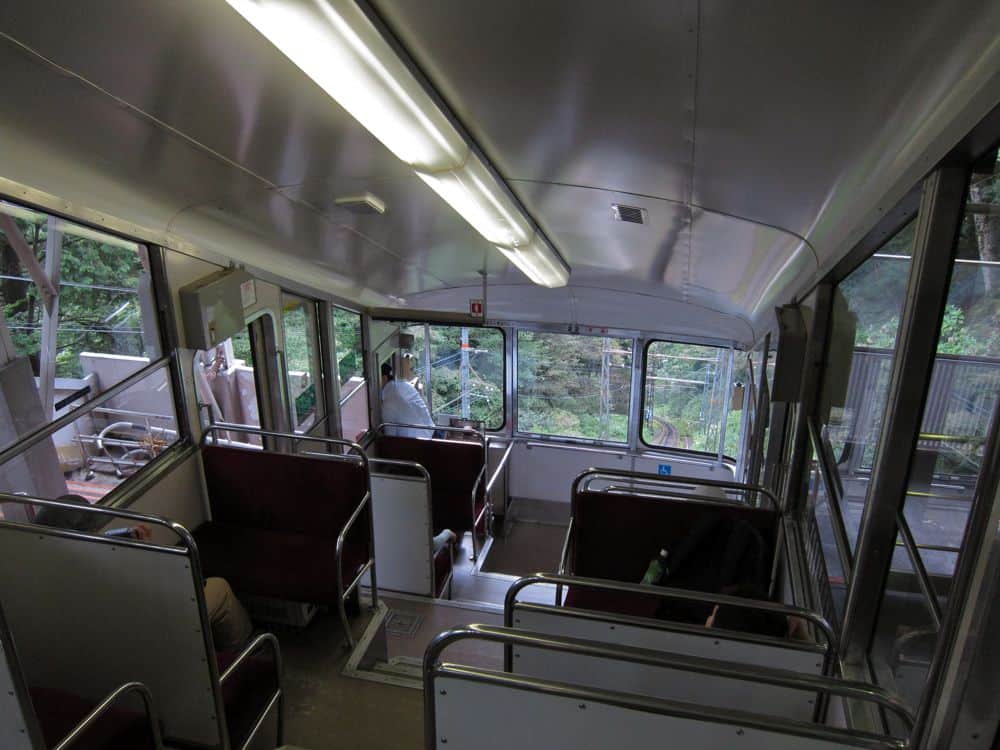
After our series of efficient trains and buses we transferred to the cable car which climbed through the forest at a precariously steep angle up to an elevation of 800 metres. The town’s bus was waiting for us and dropped us on a ghostly quiet street lined with temples – we had no idea which was ours.
Feeling hopeful we approached the entrance of one of the attractive temples of shiny dark wood. A novice monk in flowing robes came to the door and we asked for Haryo-in, the temple we had booked for the night. He put on his wooden geta and indicated for us to follow as he clip-clopped his way across the road.
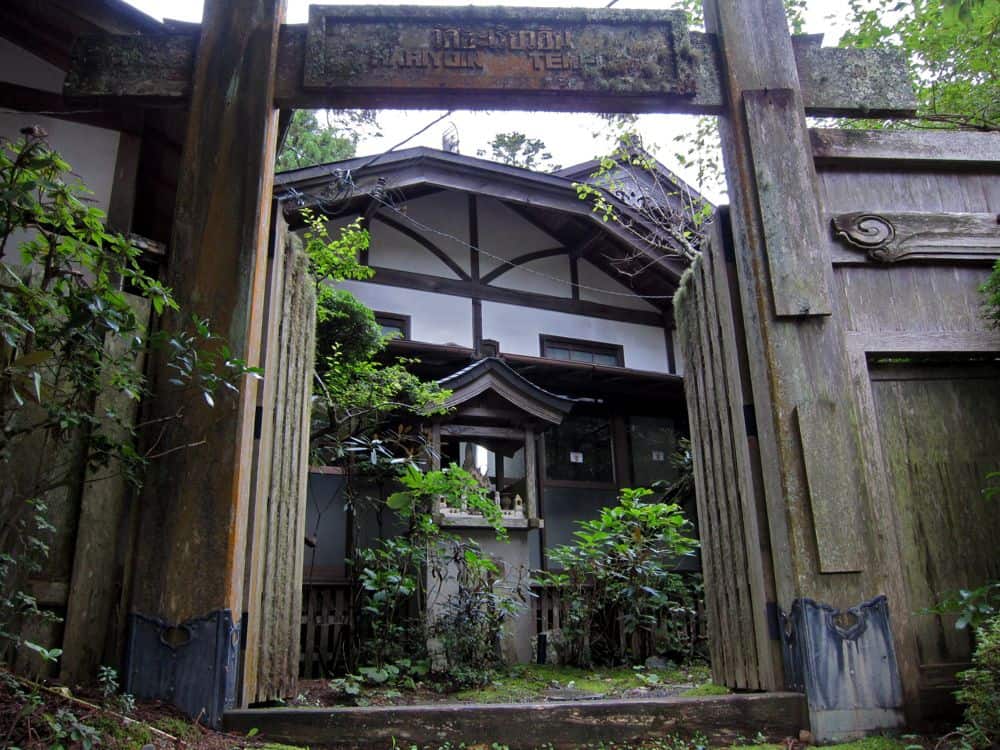
Oh. That’s Haryo-in? We stared at the shabby entrance way, decidedly less graceful than its lovely neighbours. You see, accommodation in Japan is expensive, and most of the temple stays cost about 23,000 yen (US$295) per couple per night whereas Haryo-in is a bargain 13,650 yen (US$175). Now we knew why.
As we walked through the cobweb-draped gateway into the overrun garden (very un-Japanese) a snake slithered in front of us. This didn’t seem a good omen.
It was eerily quiet but a Japanese lady did respond to our ringing of the bell and seemed to be expecting us. She spoke some English which made things easier as she took our bags and said we could come back to check in at 4pm. She also gave us an information sheet with the temple’s schedule. We had to be sure to check-in before 5pm as dinner was served at 5.30pm. The communal bath was open from 4-8pm, the temple doors would close at 9pm and it’d be lights out at 10pm. An early night was probably a good idea as the morning service was at 6.30am before breakfast the next day.
Exploring Koya-san
With five hours before check-in we set off to explore the strangely quiet town. After a vegetarian lunch at Bon On Shya café we strolled through the town, past shops selling sweet mochi and koya-dofu, a freeze dried tofu that comes from the area. Koya-san is surrounded by hills and the air is a little cooler than in Osaka – a blessing in summer. There are many temples you can visit but we focused on the two main areas – the Garan sacred precinct and the Okunoin Cemetery, one of the most beautiful places in Japan.
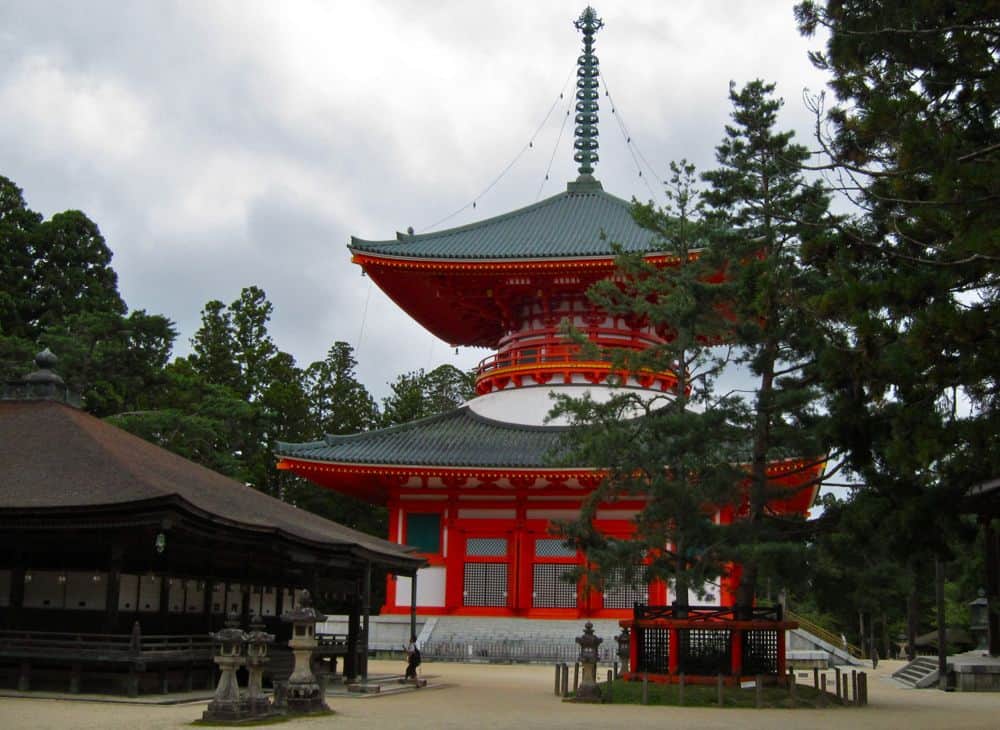
We had spent more than three weeks exploring Kyoto’s temples and shrines but the original temple complex at Koya-san, the Garan, was still impressive. Daito, the humongous red pagoda, dominated the smaller buildings around the peaceful complex. We watched a monk ringing a large bell over and over.
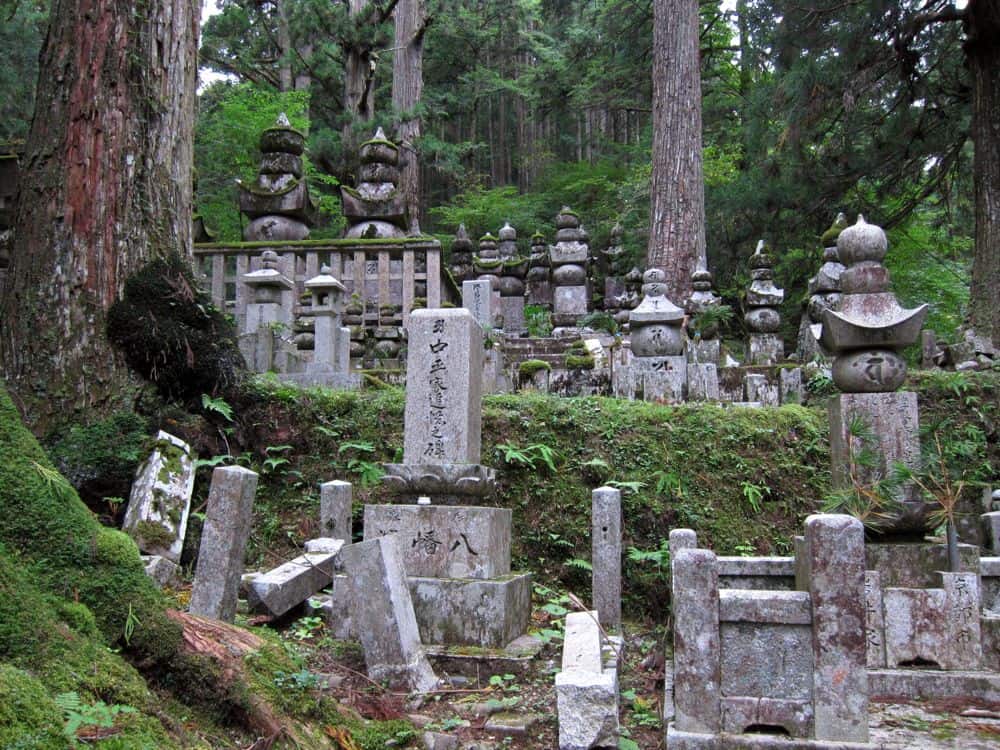
Koya-san’s main attraction is the huge and impressive Okunoin Cemetery. Thousands of tombs and Buddhist statues are found beneath giant cedar trees in an atmospheric forest. As we wandered along the quiet paths we came across a few odd “attractions”. One small wooden hut housed a large rock, which you try to lift through a window. If it’s heavy it means you are sinful. It was heavy.
In another spot we were instructed to look down a well. If we couldn’t see our reflection then we’d die within three years. We were a little nervous as we peered into the murky water far down below but thankfully saw our reflections.
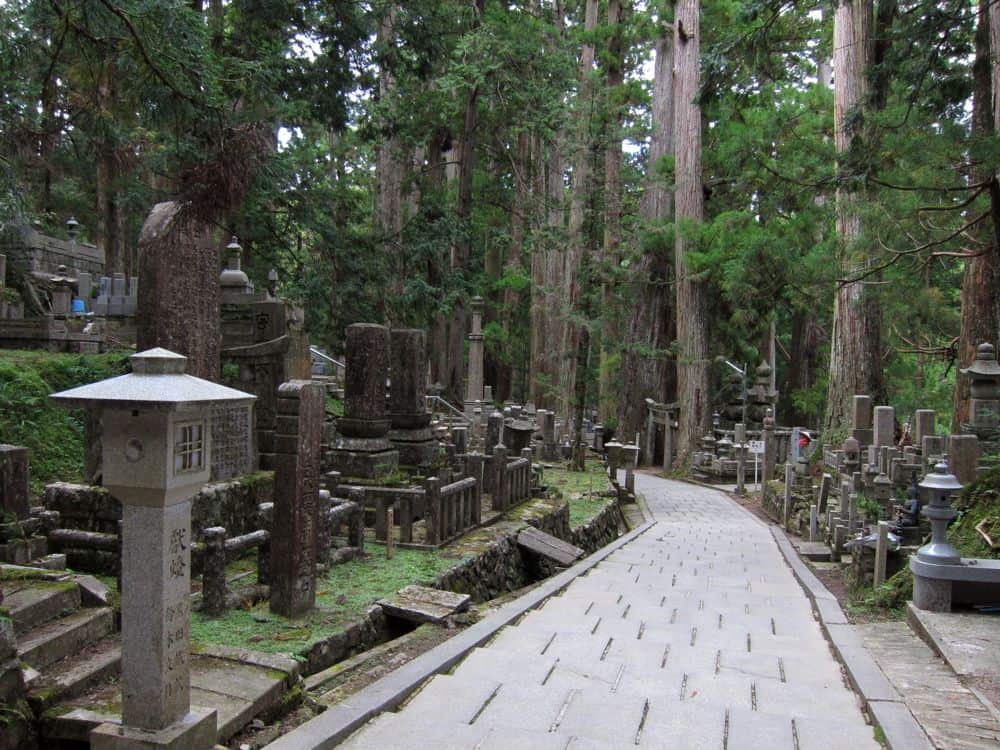
Koya-san is small so it didn’t take us long to walk from the cemetery which is located at one end of town to the Daimon entrance gate on the other side. We then wondered how we’d fill up the rest of the time before check-in. It didn’t help when it began to rain.
The Trauma of Japanese Communal Baths
We rarely saw foreigners while we were in Kyoto, so were surprised to see about eight or so while walking around this small town. As we passed we analysed them for the likelihood that they’d be staying in our budget temple lodging. Our first communal bathing experience was looming and it freaked us out. Bathing naked with tourists that we’d then be chatting to over dinner just felt too weird. We devised a strategy – we’d take our bath early and hopefully have it to ourselves.
At 4pm sharp we checked in, donned our yukatas (cotton kimono) and hurried downstairs to the communal baths –one each for men and women. We had read up on bathing etiquette so knew the drill. You leave your clothes (yes, all of them) in a tray in an outer room and walk unadorned into the bathing area. Next you wash your body and hair at one of the showers (soap and shampoo are provided) before getting into the bath.
It was steaming hot and deliciously relaxing – for a moment. We couldn’t help worrying that someone could come in at any moment. We are so used to bathing being a private activity that the idea of sharing a bath with a stranger was difficult to get used to. The bath could fit four people but it would be a little close for comfort. We managed to endure the heat and nerves for as long as we could before getting out without meeting anyone else. Success!
We needn’t have worried. It turned out we were the only guests and we only saw one monk for the rest of the night. We had the temple to ourselves.
Our Temple Accommodation
Our biggest challenge over with we headed back to our room. The temple may not be as pristine as most we’ve visited but the main part does have character with a maze of corridors overlooking cute inner rock gardens. It’s not often that you return from a bath and meet a serene monk in saffron robes lighting incense and ringing bells.
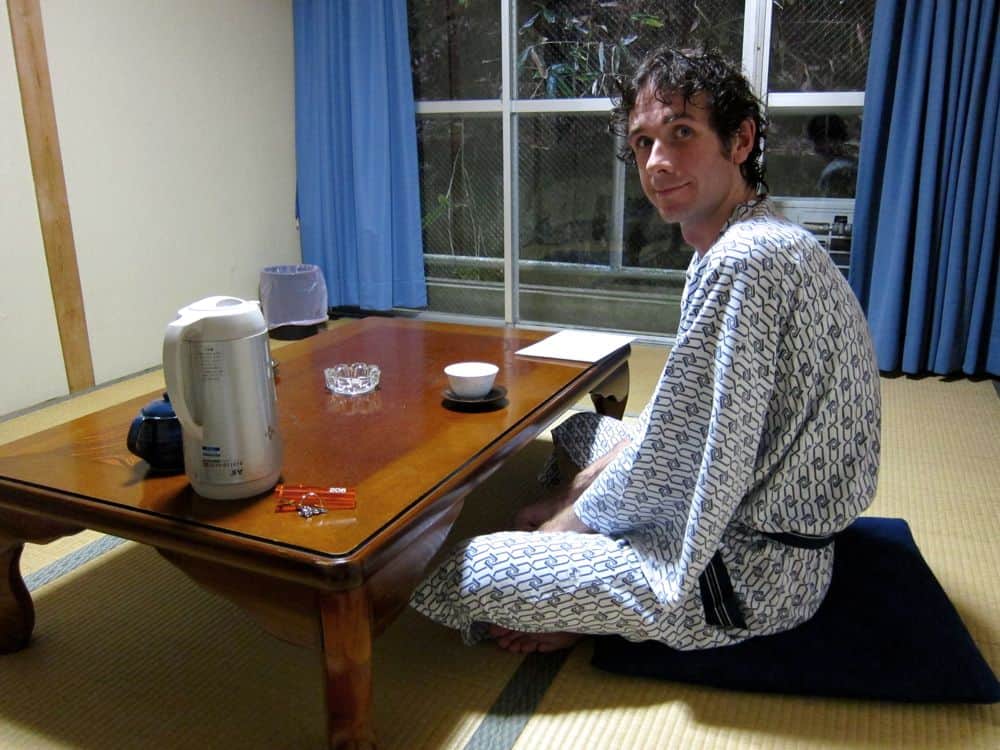
The accommodation is in a rather unattractive concrete section with a long corridor of rooms and a row of sinks and toilets at one end. Our six tatami mat room wasn’t fancy but was better than we expected. It was very Zen, empty except for a low table, two cushions and a sacred alcove with a Buddhist statue, scroll and a place to light incense. Unlike some of the more fancy temples we didn’t get a garden view – our window looked over an iron railing and greenery covered embankment. Although the room wasn’t beautiful it was our first night staying in a temple so we were excited by the new experience. In our comfortable yukatas we sat on cushions to drink the green tea we’d been left and waited for the dinner bell.
Temple Dining
The dining room was another minimalist tatami space overlooking the inner garden. Our meal was waiting for us on red lacquer trays. The monk we’d seen earlier served us rice without saying a word and left us alone to eat.
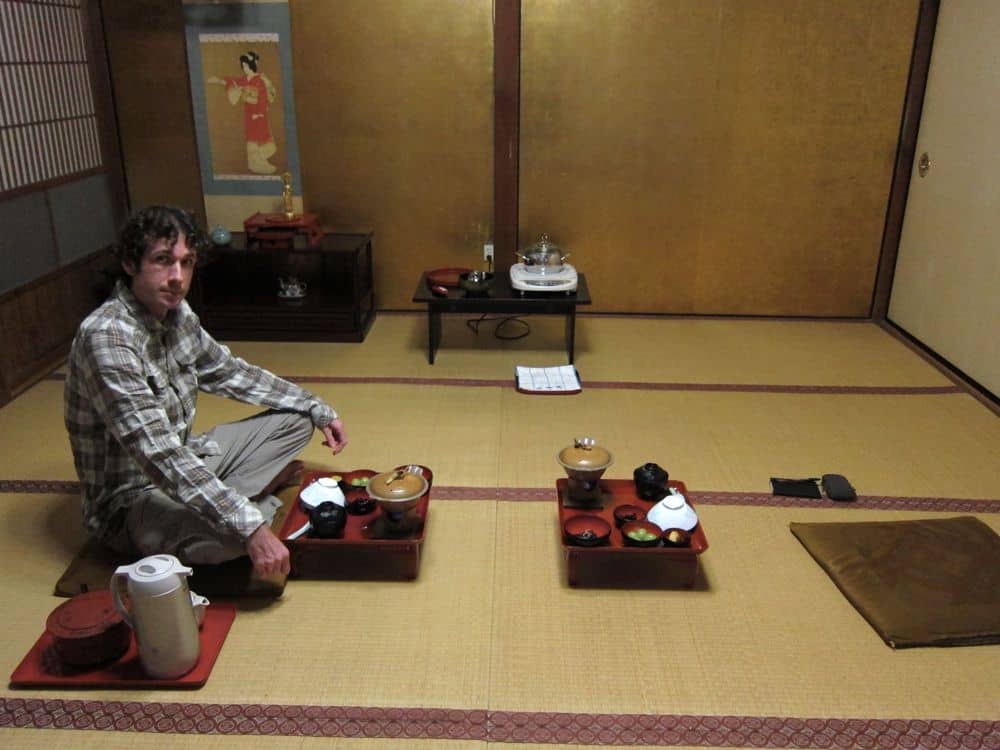
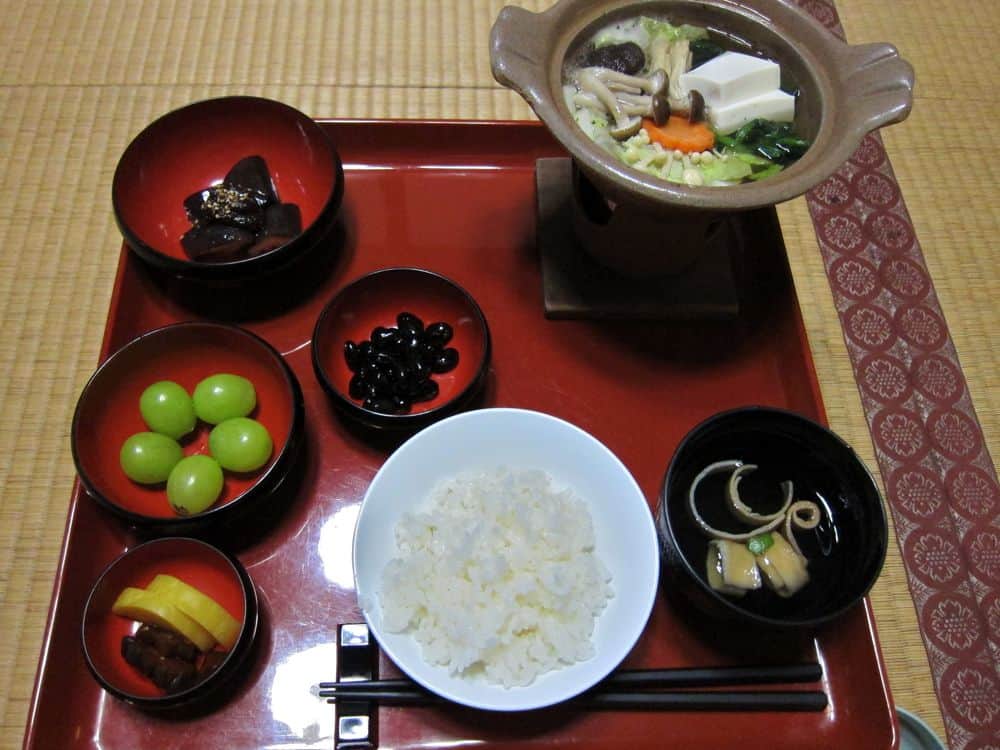
We found every Japanese meal an adventure and this was no exception as we ate our way through the simple but fresh and tasty meal of rice, miso soup, Yudofu a mushroom and tofu hotpot, pickles, eggplant in a miso dressing, sweet black beans, and grapes. The meal didn’t quite compare to the complex flavours of the shojin ryori vegetarian meals we’d had in Kyoto, but this is probably due to the lower price we were paying. Other temples may have more extravagant feasts.
Koya-san shuts down at night so there was nothing left to do but return to our room and set up our bed for the night. In traditional Japanese accommodation you sleep on futons – thin mattresses that are stored away during the day and brought out to sleep on. We stacked up a few for added comfort and added the straw-filled pillows.
Morning Chanting
In the morning we were woken at 6am by a series of gongs and made it down to the main temple room for the morning ceremony. We had expected more monks but it was just us and the monk we’d met the previous day, although we still hadn’t spoken. We sat on the floor in a large tatami room facing into a neighbouring room which looked like a dusty antique shop full of golden Buddha statues and tall candle stands. The monk had a limp and it took him some time to move around the room lighting all of the candles.
When he was finished he sat on a large cushion amongst the Buddhas, facing away from us, and began to chant in a deep voice. Of course we couldn’t understand any of it but could follow the intonation. Sometimes he slowed to a conversational pace, sometimes becoming louder and more impassioned. His chanting was punctuated by hitting gongs, ringing hand bells and blowing into a wind instrument. The momentum built and things became even more exciting when he lit up a fire in front of him.
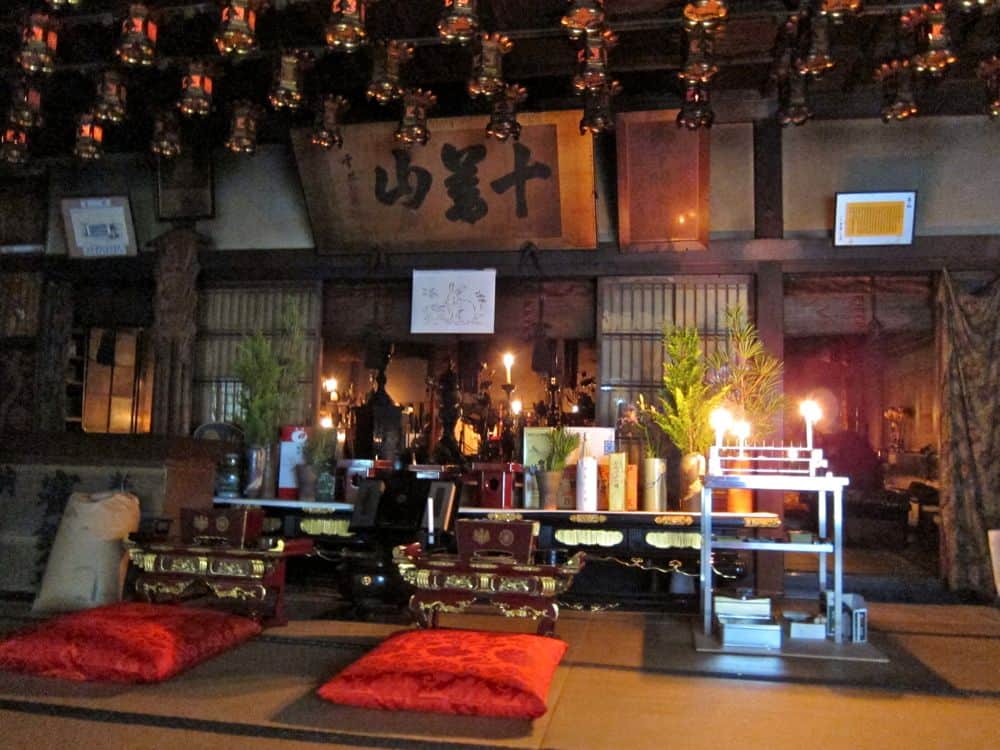
Another elderly monk entered the ceremonial room about half way through. Tardiness didn’t seem in keeping with the temple ethic, but this was an unusual temple. He sat quietly at one end, sometimes muttering to himself.
When the ceremony came to an end the elderly monk disappeared and the limping monk entered our room. Should we leave? Is there more? We waited, unsure.
The monk surprised us by talking for the first time. We had assumed he couldn’t speak English but although we struggled to follow everything he said he spoke it quite well. He told us the story behind his limp, how he had an aneurysm 14 years ago leaving him paralysed in one side and was told he’d never walk again. With determination he managed to though. I’m sure there is more to the story but unfortunately we couldn’t understand it all.
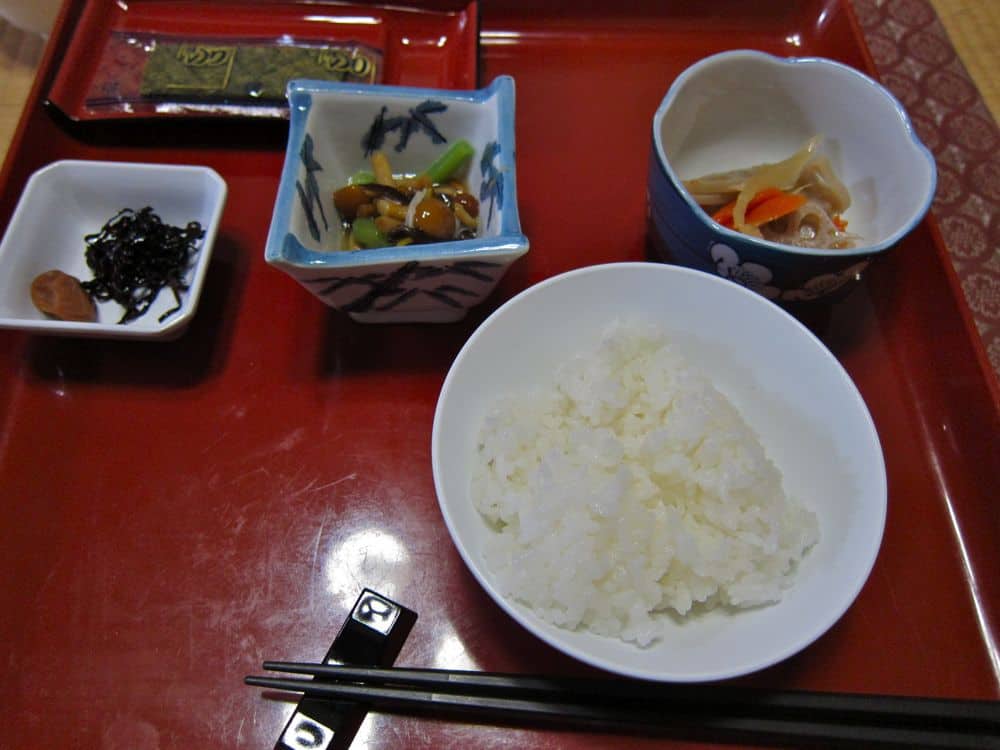
Breakfast was waiting for us in the dining room – a traditional meal of rice, miso soup, two types of seaweed, pickled plum, cold mushrooms in a marinade (surprisingly delicious) and cold lotus root and carrot.
It was still early but there wasn’t much to wait around for so we said goodbye to the monk and went on our way. It was a fascinating experience and one we’d recommend. If you can afford the more upmarket temples though you might want to splurge.

Times have changed.
Temples have heard the chink chink sound of money loud and clear! There are now over 50 temples in Koyasan providing overnight lodging. They have even banded together to provide information
If you want to go via traditional ways of booking, check out this link.
https://www.japan-guide.com/e/e4905.html
Enjoy your shukubo ! (Temple stay)
Hello! I was hoping that even though it has been a couple years since your trip, you could give me some pointers. My family and I are travelling to Japan in June, and we are looking to do a temple stay in Koya-san. After your experience, is there a specific temple you suggest staying at? Thank you so much!
Can I ask how you booked the Haryo-in? My sister and I are looking for a temple to stay in for a night when we go to see Koya-san.
Thank you!
Can I ask how you booked the Haryo-in? My sister and I are looking for a temple to stay in for a night when we go to see Koya-san.
Thank you!
Your story mentioned your many methods of transportation from Kyoto to Koya-san. Do have any directions for the best way from Kyoto to Koya-san?
Here are directions: http://www.japan-guide.com/e/e4904.html – You go by train via Osaka.
This comment is about 4 years late, but I thought I’d post anyway! Koya-san is definitely a fascinating place to visit, but for me, as a Buddhist, it was even more meaningful as a pilgrimage. Koya-san is the center of the Shingon tantric Buddhist school. Even though my main practice is Zen meditation, I participated in the kechien-kanjo, which is the main tantric initiation for lay people. Staying in a shukubo is also very interesting but you need to be ready for traditional Japanese accommodation, rather than expecting a hotel. For example, you need to be ready to eat on time, you need to be quiet and go to sleep, rather than coming in late and being noisy. Erin mentioned sleeping on futons and there are often rather spartan communal toilets. The fear of communal baths was understandable, we Westerners aren’t used to it, actually young Japanese aren’t either! So the key really is being flexible and willing to experience an immersion in traditional Japanese culture. An excellent preparatory book is Sacred Koyasan: A Pilgrimage to the Mountain Temple of Saint Kobo Daishi and the Great Sun Buddha by Philip L. Nicoloff
Thank you so much for all your wonderful posts! They are so inspiring.
I will be visiting Japan coming March/April, and have limited time (about 9 days). So far I was planning to stay about 6 days in Kyoto and 3 in Tokyo. My question is: do you think it is worth to visit Koyasan and stay one less day in Kyoto?
And for Kyoto, do you have any recommendations for staying in a Temple ?
Thank you!
We love Kyoto and you could easily spend 6 days there, but Koya-san is a unique place so I would definitely try to get there. I don’t know about temple stays in Kyoto I’m afraid.
Hi Simon and Erin,
This will be my first time travelling to mount koya. Infact it will be my first time travelling to japan alone. What is the safety precautions I should take when in japan?
Your blog has really inspired me to make the decision of travelling to japan. However, I am very nervous as it will be a new challenge in my life.
Any advice given to me will really help me with everything.
Thank you
Vicky
What to do or not to do in case of an earthquake is a good thing to know.
Apart from that, you’re good.
If you’re worrying about safety from “bad people”, remember, this is the country where people save their table at the coffee shop by leaving their cell phone on it while they’re waiting in line.
We found Japan to be one of the safest countries we’ve ever visited so I wouldn’t say there are any particular safety precautions you need to take.
Forgot to mention I booked on line through a Mr google search and received very prompt reply.
Have also done the communal bathing during my 8 trips to Japan over 20 years and you really do get used to it after the first couple of times. Didn’t participate this trip however as I have had both breasts off due to cancer. I consider myself fortunate to be alive and well but thought it might be somewhat inconsiderate to the Japanese ladies.
A great read. I am just back from 3 weeks in Japan and we stayed in a temple in Takayama. It was 3000 yen per person but no meals however a nice kitchen to use. It is less than 10 mins walk from the station. Stayed there 6 years ago and at another temple which is listed as a youth hostel further from the town 20 years ago.
I also have the same question do you Just show up or do you have to make appointment? As to what I read it sounds like I just show up!!
You do need to book a temple stay in advance.
I thank you, for your information, I have always wanted to spend time with the Monks. and after reading this I surely am going to do this at this facility. My daughter resides in Japan so while I am visiting Next month and we are over that area I will be sure to append my night with the MONKS.. BUT I THINK I WILL BE A BIT MORE CURIOUS IN SEARCHING OUT THE MONKS.. I want to be around them that is what the experience is about!!
Hi, I enjoyed reading your posts as I plan going to Japan the last week in may and the first week in June… A few quick questions
1. How did you contact and book a room in Koya San and search for other temple lodgings
2. Can you recommend any similar experiances in Kyoto, Takayama, or Mt. Fuji area and if so how would one contact these places
Thanks
We embarked on a similar experience in Koyasan last year and despite the freezing cold (well it was January!) we loved it too and would highly recommend it to anyone wishing a truly authentic experience in the stunning quiet mountains of Japan!
I had a similar experience in Risikesh..got an opportunity to stay in an ashram and it was really great experience…your post reminded me of those golden days..
Thanks so much for this amazing post about your stay in the temple! We are traveling to Tokyo in May and are definitely going to Mt Koya to stay overnight in a temple…hearing your experience was very informative and entertaining! We’ll be splurging for the more upscale temple… We’re also going to stay in Kyoto and near Mt Fuji. If you happen to have any advice on fabulous places to see / things to do, I’d love your input. Thanks again for sharing about your adventure!
Great post, I really appreciate the detail. I’m trying to decide whether to stay on Koya-San or attempt the rather long daytrip from Kyoto next February. While the idea of staying up there appeals it will be middle of winter and could make for a less comfortable experience.
That sounds like a fantastic journey! I’m excited to stay at a few American Zen Buddhist temples and perhaps overseas in a Japanese one some day.
Thank you for sharing!
Hi! I just came back from a 3-week trip in Europe and your posts on packing light really helped me a lot! Thanks so much!!
BTW my friend just wrote an interesting article on onsen/public bath in Japan. Thought you might be interested ;)
http://www.tofugu.com/2014/08/14/lets-all-get-naked-onsen-and-body-image
I totally envy you for this experience. I am a fan of Japanese cuisine and culture and your trip sounds amazing. Thanks for your real and colorful story, reading it I felt like visiting the temple myself. Keep travelling and keep sharing!
Hi, just back from Japan and happened to see your blog. A great, reflective story – thanks for sharing!
I just wanted to say, I can see how the shared bathing might seem daunting – but it is such a fantastic experience. It is not weird and if you can give it a go you will soon notice it is as natural as anything else in life. You wonder how you ever thought that being naked was not normal!
:) Thanks again.
I’m in love with Japan and when i stumbled your website now i’m in love with your page design also :) I really hope to end up in Japan soon, its very expensive for me right now :(
Hey Erin and Simon!
My husband and I are also traveling for a while and our next stop is Japan for 20 days in March.
1) Re: “Sleeping with the monks”, would you reccomend this experience?
2) As far as an itinerary goes, with the exception of Koyoto, I’ll be following your schedule. Since we will only have 20 nights, how long do you think we should plan to stay in kyoto?
3) would you have done anything differently visiting the other cities- staying longer or skipping all together?
4) Lastly, what areas did you cover with your 7 day JR pass?
Thanks so much in advance for your time and help!
Do you know how the temples feel about children staying?
I’m afraid I don’t know.
Love the blog. I felt like I was there. This is something I’ve always wanted to do. Did you do any temple stays in Thailand?
Thanks. No, we’ve only done the Japan temple.
I spent my years in Japan visiting temples. There are temples here in Japan that you could stay. A one year study in Hiroshima Bukkyou Gakkouin would make us understand the Beauty of Buddhism. Please feel free to visit my facebook account. Gasshou, sheryl mohri
I have been to Koya San twice, the second time with my grown son in tow. Because the communal toilet facilities were a pain the first time around, on the second trip I splurged and found a temple, Sekishoin (right next to the cemetery) that had a tiny private bathroom. Made a great difference in “comfort.” The food tasted great, only it was always cold because they fixed it in the early afternoon for the 5:00 dinner. The entire area is unique in all of Japan. It’s very spiritual.
You can find business hotels in Japan for about $60/night, which isn’t that bad. They’re small, but they have all that you need, and presumably you don’t want to spend a lot of time in your hotel room anyway. I would never pay over $200/night anywhere unless I had a big change in my financial situation, which isn’t particularly foreseeable.
There are no business hotels in Koya-San though and staying in a temple is about the experience rather than just a place to sleep.
until i read this, i had the blessing of being the only american to stay overnite
in the temple in bangkok area in 1976, returning there sept 29 2012 to find
the wot, we had to get there in a boat taxi, cant remember the name i am now 73
That must have been amazing—both the original experience and to return there.
Would have been nice if the monk gave you more insight into the ritual and other Buddhist practices. Really nice story anyway!
” Koya-san, the respectful name given to Mount Koya”
Sigh. ‘San’ is the pronunciation of ‘mountain’ when paired with a name (‘mountain’ alone is yama, but ‘Mount Fuji’ is Fujisan). Koya-san means Mount Koya, that’s all. It’s not the same word as the respectful -san.
Erin and Simon, thank you so much for this great review of your time there
Thank you. Again. Looking over this post again cemented our need to stay in a temple during our time in Japan. So looking forward to it!
Excellent! Splurge on one of the more expensive temples if you can afford it.
Thank you for putting pictures it definitely gave me a better idea of the place and better understand the peacefulness that came with it. Also, I’m glad you guys saw your reflection looking down at the well!
We were glad about that too :)
Communal bathrooms…had a couple of those before in Spain, such a pain in the ass…either be so early or so late, to make the least interaction with people :D
but sounds like you had a great experience…Buddhists seem to amuse me in so many ways, I have to see mroe of this culture than just read about it!
We were really fascinated by Japanese culture. We’d definitely recommend a trip there.
I would’ve had a difficult time bathing in a communal bath as well! Sounds like an unforgettable experience, in many good ways!
Despite the bathroom challenge it was an amazing experience!
Something I’ve not yet done, but would love to – very high on the wish list, very eager to return to Japan.
I’m sure you would love it Lara.
I’ve heard rumor of the Japan price tag, but I am always astounded at the numbers I hear from travelers. Great story. Japan is on my list, but not until I am done with China.
To be honest, when I look back I’m astounded by the numbers! When you are there you almost get used to it because it’s all relative, but now I can’t believe what we spent on accommodation in particular.
Sounds like you had a great experience.
I have yet to go to Koya-san, but it’s definitely on my list.
Oh, Koya-sama! The best place we visited in Japan – by far!
We stayed at Shojoshin-in (right next to Okuno-in) in our own hanare, it had its own traditional Japanese bath. Koya-san is small, but the cemetery is huge! Did you get through it all?? We barely made it half way down the main path before we had to turn back for dinner.
I’m surprise you only saw a few people travelers. Despite the crazy amount it took to get there, there were more than we expected! Then again, we arrived mid-day. The next morning, there were very few.
My husband proposed to me here, and, don’t tell him, that’s not my favorite part about the Koya visit! It’s simply amazing!!
I’m so pleased you enjoyed Koya-san too Andy. We did manage to get all the way to the end of the cemetery – it is huge isn’t it?
We hardly saw any other tourists in Japan except for in Tokyo. It might be because the earthquake put people off last year, or because it was the summer.
Awesome! I’m so glad to see reporting out of Japan – it’s been a while since I’ve seen a post. We love authentic experiences like this – and it looks like this one was worth the crazy amount of vehicles involved! Thanks for sharing your experience with us! -David
Thanks David! It was definitely worth the effort to get there, and they do make it so easy for you in Japan. We loved the efficiency!
The communal shower is not so bad — it’s like the shower at the public pools back home! Except I never go to public pools back home anymore… :)
It was more the prospect of sitting next to a stranger naked in a smallish bath that freaked us out!
Wow that sounds like a really interesting experience! I think you would have gotten used to the communal bathing things pretty fast though. It is easy to forget to be shy when no one else around you is shy.
That’s true. As it wouldn’t have been a bit deal for the Japanese, we would have felt silly worrying about it. Kind of glad we didn’t have to go through with it though!
Have been really enjoying your Japan posts. Keep them coming!
Thanks Jeff!
Yeah Japan ain’t cheap unfortunately. But sounds like a very interesting experience. When I was in Japan few years back, we splurged to stay in one of the nice onsens (hot springs) for few nights, it was very nice, relaxing and loved it. Of course there was communal nude bathing, but being from Finland, for us it just seems very normal :) very relaxing
We heard good things about the onsens but it was too hot in the summer for them. If we go back at a cooler time we’ll have to get over the nude bathing thing and give them a try. You Europeans are much cooler about these things :)
Fascinating post with a good dose of good information about staying in a Buddhist temple, which is on my bucket list. I really like the photos. They really help tell the story. I don’t know if you like to watch movies, if so, I highly recommend a German film called “Erleuchtung Garantiert” (“Enlightenment Guaranteed”) a funny, but poignant film about 2 brothers who journey from Berlin for a visit in a Japanese temple.
Thanks Mark. Sounds like a great film – I hope we can track it down.
My wife studied Japanese in college and has never been. I show her this and I think we are on the next plane out! Very nice!
You should go! :)
What a cool experience! And great photos! I would not like sharing a shower either, haha.
It is hard to get used to!
Wow, sounds like a beautiful way to spend a peaceful day (and night), especially the morning ceremony. Love the photos!
Thanks Bret. The morning ceremony was really interesting, even though we felt a little voyeuristic.
Wow, that sounds like a different experience. Looks very calming.
It was a peaceful place.
I’d really like to do something like this! What a cool experience.
Hope you get the opportunity one day.
I looks like to be quite an experience to have stayed at a Japanese temple. Gosh! I would have rather big difficulties sitting on the carpet and eating! :)
We had to get used to eating on the floor in Japan as all traditional restaurants are like that. Our legs did go dead sometimes!
Sounds like quite an experience though the bathing doesn’t sound quite as relaxing as it’s supposed to be.
Not so sure about the Japanese breakfast. I’d like fruit and not pickled veges first thing.
It does take some getting used to. I loved the pickles actually, but the seaweed, not so much.
What an amazing experience! The price seems quite high (especially for the more upmarket temples) but I think it’s totally worth it for this unique travel experience. Makes us want to go to Japan even more ;-)
Yeah, it was crazy expensive but that’s just Japan. Totally worth it for such a unique experience. Hope you make it there!
I’d really like to visit Koyasan when I’m in Osaka at the end of the month, but I think a temple stay is a bit out of my budget – as much as I’d like to do it!! Have you ever been to Korea? There are also temple stay programmes here, and they are SO much fun (though the morning chanting is usually around 4 AM, yikes!). I’ve been to two and am still looking at a third. Also, they’re only 50,000 won for a 2-day-1-night stay, which is something like $40!
But they don’t come with yukatas and communal baths ;)
That sounds great Naomi! Good to know you can stay in a temple on a budget there. We haven’t visited Korea but will keep that in mind when we eventually get there. There used to be a hostel in Koya-san but I think the place we stayed is now the cheapest option, which is a bit crazy for budget travellers!
Communal bath sounded kind of nerve racking. But if you knew you had the place to yourself it could have been much more relaxing, or that’s how I pictured it through your (excellent) story telling. This was a great post, opened my eyes to an experience I rarely thought of before. Thank you.
It would have been so much more relaxing if we knew we had the place to ourselves! We feel kind of prudish freaking out about it so much but we grew up in such a completely different culture to Japan that it’s hard to get used to. Glad you enjoyed the post Cori!
The communal bathing was amusing. I don’t what we’ll do when we come across this aspect of travel — sink washing?
I think you just have to throw yourself into it! We were tempted to skip the baths but knew we’d feel bad if we did. We got lucky anyway and had them to ourselves!
Fantastic piece about experiencing a life that many see in passing but never have the opportunity or knowledge to truly experience. I hope this encourages others to try out a similar stay in Japan. I know it does with me and makes me wish I had taken the option on my RTW ticket to visit Japan, despite all the troubles at the time.
Greg
Thanks Greg. I hope you (and others) are able to visit Koya-san one day.