This page contains affiliate links. Please read our disclosure for more info.
We heard from other vegetarians who had travelled through Bolivia that we’d be eating a lot of egg and chips (unfortunate as we don’t like eggs), and have to put up with finding bones in supposedly vegetarian soup. It didn’t sound promising. We spent seven weeks travelling around the country, and although we wouldn’t recommend it as a foodie destination, we managed and only had to eat eggs a few times. As always in South America you can survive as a vegetarian, but it does take some searching.
Here are our tips for travelling as a vegetarian in Bolivia.
Just Ask
Our first stop in Bolivia was the border town of Villazón. We had a few hours to kill before our onward bus to Tupiza so we wandered into a local eatery wondering what on earth we’d find to eat. We asked (in Spanish) if they had anything without meat. “Chicken” was the response. Er, no chicken either please. They ended up bringing us a big plate of rice, salad and fried potatoes. Exciting, no, but definitely passable.
We also managed to get good vegetarian food on our Tupiza Tours salt flats trip. We mentioned our dietary needs quite a few times just to be sure, and were specific that we don’t eat meat, chicken, ham or fish.
The ‘just ask’ advice doesn’t always work though. The women at the Sucre market stalls looked at me like I was crazy when I enquired about meat-free options.
Eat at Gringo Restaurants

It’s a sad truth that the easiest place to find vegetarian food in Bolivia is at the gringo restaurants you’ll find in every town on the tourist trail. It’s a shame because they are a lot more expensive than local eateries (around 30B for a main) and you miss out on the experience of trying local food, but often it’s your only option. Pizza and pasta is found everywhere, and if you are lucky you’ll find something more interesting.
Gringo highlights for us were the lentil burgers at Cafe de la Jungla in Rurrenabaque, vegetable ratatouille at Latina Cafe in Samaipata, vegetarian tacos at La Cueva, La Paz, pizza and other goodies at Minuteman Pizza, Uyuni and breakfast burritos at our guesthouse in Samaipata, La Posada del Sol.
Search for Veggie Lunch Places
Most big cities have vegetarian restaurants serving up set lunch menus. These can sometimes be dreadfully bland but are filling and cheap (10-17B). The best options we found were El Germen in Sucre and Namaste in La Paz. Have a look on Happy Cow for more options.
Papas Rellenas
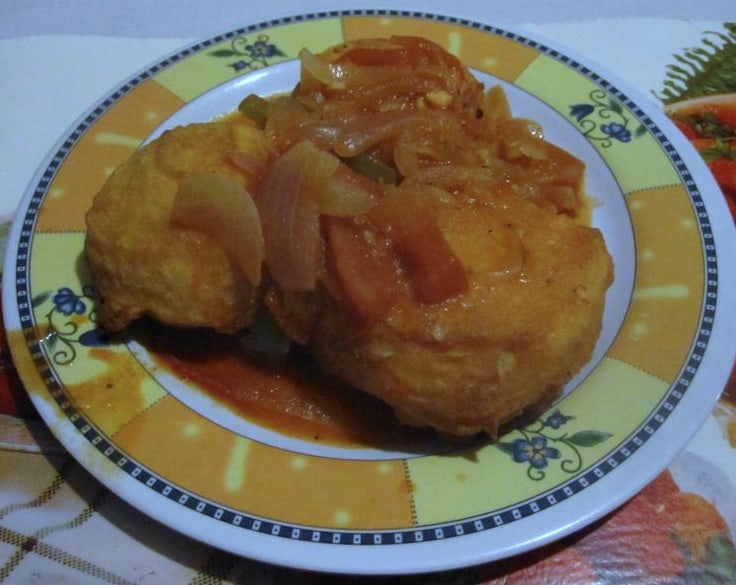
We were happy to discover a traditional Bolivian food that is vegetarian friendly. Mashed potato is formed into a ball, stuffed with cheese (or egg or meat), fried in a batter and served with a spicy sauce. Very tasty and extremely cheap at 3B per potato.
These aren’t as easy to find as we would like but we did find a good place to try them in Sucre.
Cheesy Santa Cruz Specialities
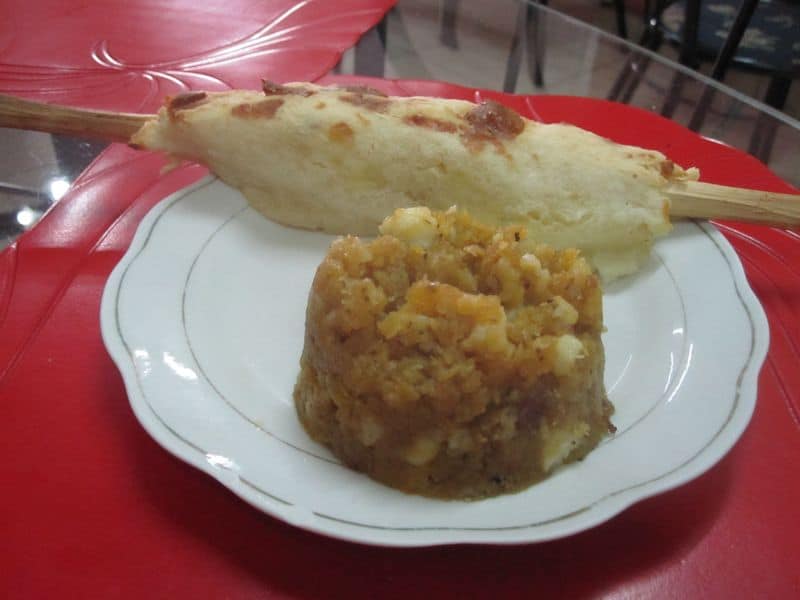
In Sucre we discovered Las Delicias, a popular Bolivian cafe serving up lots of veggie-friendly traditional snacks from the Santa Cruz area. Unfortunately for vegans they all included cheese:
Humintas – mashed corn and cheese served steamed or baked in a corn husk.
Sonso – mashed yucca and cheese served on a stick and cooked over coals.
Masaco – mashed banana and cheese.
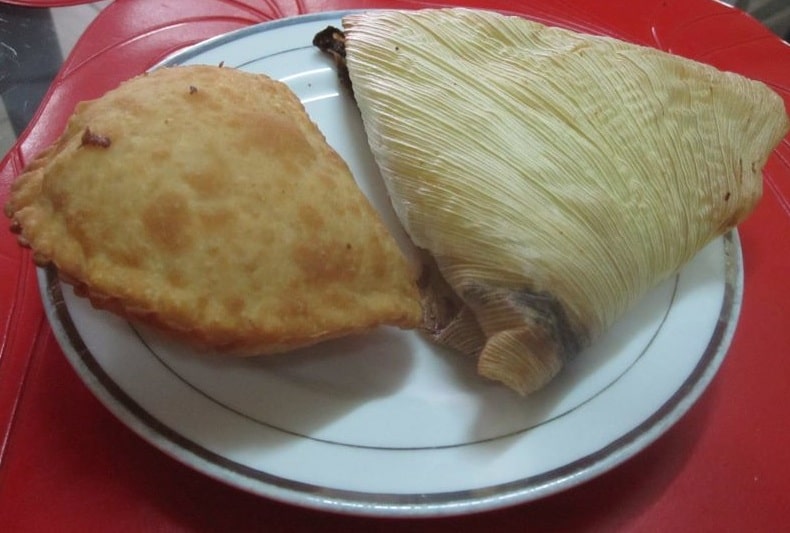
You can also find empanadas (pastries) but we didn’t find cheese versions very often, and they were not as good as the Argentine versions.
All of these except humintas are quite difficult to find when travelling around the country.
Stock Up on Dried Snacks
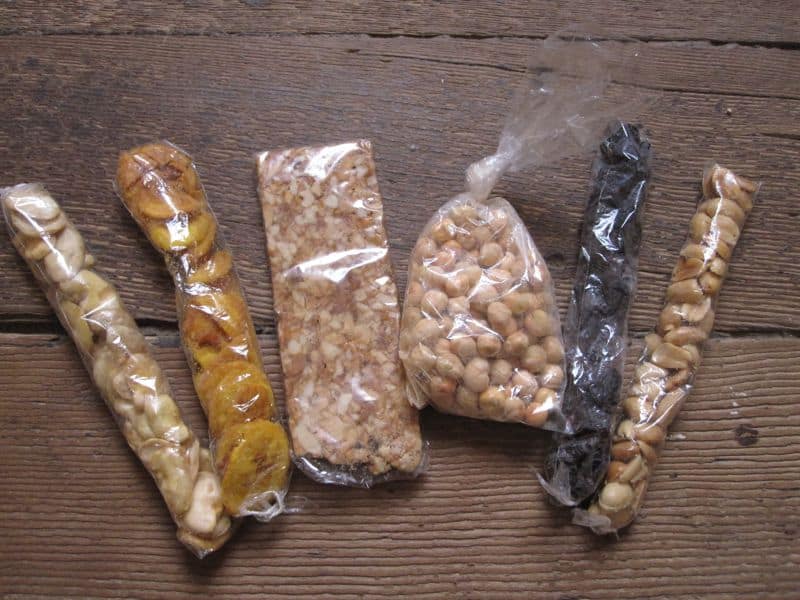
For long bus journeys and tours where you aren’t sure what the vegetarian meal options are like, stocking up on snacks is vital. Simon’s choice is pringles and oreos, but for a cheaper, healthier alternative Bolivia has lots of great dried snacks. It’s easy to find street stalls selling packs of nuts, raisins, dried chickpeas, fava beans, banana, and peanut bars. For 1-2B these are great value.
Enjoy the Fruit
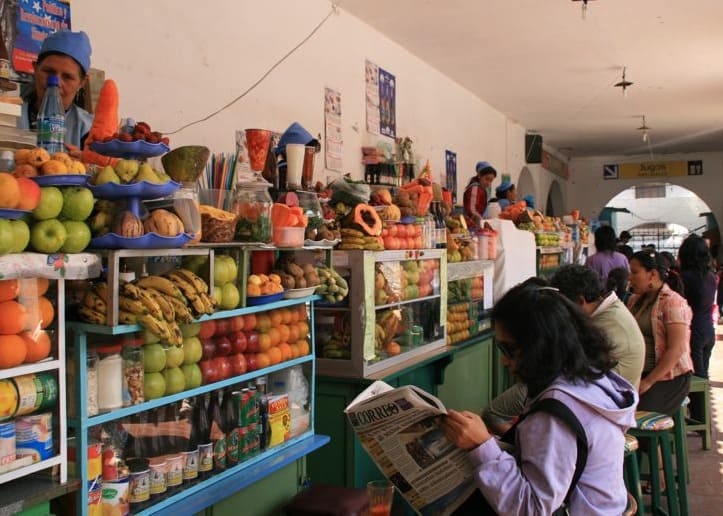
One of the best things about Bolivia is the easy and cheap access to tropical fruit and juices. You can find street stalls selling freshly squeezed orange juice for 3B everywhere, and often the markets have rows of fruit juice stalls with blenders to whip up your choice of juice. A huge range of tropical fruit is available: custard apple, prickly pear, passionfruit, papaya, pineapple, mango and more.
The markets are also well stocked for self-catering.
Add Spice with Llajhua
We were spice-deprived after Argentina but luckily chilli is easier to find in Bolivia. The spicy tomato and chilli sauce llajhua is found on most restaurant tables. In local restaurants if you have ended up with a plate of plain rice and boiled vegetables this is a great way to add flavour.
Learn Some Spanish
It’ll be on all of our South American survival guides: your life will be easier if you can speak some Spanish to explain your eating requirements and check if a meal contains meat. A useful phrase to know is “Soy vegetariano/a” (I’m a vegetarian), although it is better to be more specific: “No como carne, ni pollo, ni jamón, ni pescado” (I don’t eat meat, chicken, ham or fish).
We have written a comprehensive guide to vegetarian eating options in Sucre. If you are travelling as a vegetarian around South America you can also read our survival guides to Brazil, Paraguay and Argentina.

Hey there I know the post is a few years old but just incase you ever go looking for it back home the dish is actually called “humitas” not “humintas” I’m also surprised to see platanos/tostones missing from this list! Sadly almost all Hispanic food tends to be high in fat, which stems from poorer communities needed to add nourishment cheaply (which is where refried beans originate.) Nowadays we have all the fat we need haha
My email is [email protected]. Have a good journey!
Dear fellow nomads, I am from Bolivia, 7 years vegetarian and I know very well about issues for us to find vegetarian food here. If someone goes to Bolivia, you are welcome to my house and I will be glad to receive you as guests with a tatsy, traditional and healthy vegetarian food. P.s. Just take care about “huminta”, there is a picture about it above, and it seems to have just cereal and cheese, but it is usually cooked using pig fat.
Thanks for the info and for the kind offer!
Great stuff, thanks for the tips. I am going to Bolivia next month, so this post is very useful for me. Have a good journey!
Erin and Simon,
Awesome tips! I leave for Bolivia and Chile on July 13, 2013. Wanted to prepare myself to face the dilemma of searching for a vegetarian restaurant to eat in La Paz, Uyuni…
How many days tour of the saltflats that you recommend? Did you guys do any trekking while you were in Bolivia?
I look forward to your email.
Bhan
We did a 4 day salt flats tour from Tupiza and really recommend it. More info here: http://www.neverendingvoyage.com/bolivia-salt-flats-salar-de-uyuni-part-1/
We didn’t do any trekking. Enjoy your trip!
Hi Simon, What is the name of the cooking class where you learnt to make Papas Rellenas? Would love to go to a cooking class while I’m down in Bolivia!
It was part of our Spanish lessons at Sucre Spanish School.
Great article! I have to add that I ve been in three vegetarian restaurants in La Paz, one in ” calle campero” , the other one is call Armonia don´t really remember where it is… and the last one in the Hotel Gloria ,great buffet ! exect to pay between 10 to 25 Bs. or 2 to 4 american dollars!
Dear fellow nomads, I came unto your site looking for anything vegetarian in Trinidad, but looks like i´m going to scout yet another pizza.
Good post though, I agree with most of the tips! Sucre has about 5 veggie restaurants by the way for lunch.
Especially the last tip is important, chicken (pollo), jamon (ham) and fish (pescado ) / seafood (marisco) are all considered vegetarian.
Sorry we couldn’t help – I hope you find something other than pizza!
Thanks for all the great information, this has been really usefull to my girlfriend and I. My girlfriend is vegetarian (and that practically makes me one too!).
We are currently in Sucre at the moment, about to go to Snack Luis Comida Real to try out the papas rellenas! can´t wait to finish this entry!
I thought it would be worth mentioning another great vegetarian snack we have found in Bolivia. Salteñas are similar to empanadas, but much better in our opinions! They are filled with onion, small pieces of potatoe, a couple of olives and ´caldo´ (kind of like a sweet soup.
They come in various flavours (pollo, caldo, carne, VEGETERIANA ;). The draw back is that they seem to generally only be available in the morning, as the vendors bake them at night/early morning, and then they get sold out by lunch time.
You can occasionaly find vendors with carts wondering around Sucre (cost 2/3 bolivianos), but it is easier to find them in a Salteneria. The one we use most frequenly is on Calle San Alberto, next to the Fox language school.
Hope you enjoyed the papas rellenas! We never saw salteñas in vegetarian flavour – shame we missed out.
Loved the article. I’m living in Sucre, and trying not to get bored with the vegetarian offerings. At least I can cook at home. I thought Pizzeria ‘El Maná’ deserved a mentioning. It’s by the bus station, and has a to die for veg pizza. They even have a wood oven! I’ll be sure and read your postings about other countries once I start traveling. Thanks!
We liked El Mana too, but the choices in Sucre must get boring after a while. Having a kitchen makes such a difference though.
I love your veg survival guide series! Luckily I started in Colombia and (eventually) will head south. I’ll have to check back before I hit up each country for your recommendations :)
Glad you found it useful Jasmine. I’m looking forward to trying the Bogota veggie restaurants you recommend.
You guys rock with these posts! Just wish I had read them years ago. That pizza looks insanely delish!!!
Thanks Andi! The pizza was sooo good =)
Ah, Minuteman Pizza… We live in Japan now and we’re still talking about that place. We went 2-3 times, I think. After foraging for vegetarian food in Bolivia for 5 weeks, we were so happy to find it!
If we hadn’t already booked our bus tickets we probably would have gone more than once. Glad you enjoyed it too.
Great post! These are helpful tips. As a vegetarian, I found it difficult to find inexpensive, tasty food in rural Peru and Colombia. I didn’t travel to Bolivia, but it sounds similar. The most difficult thing for me was dining with a meat-eating traveling companion– and watching him feast on $1.50 lunch platters (steak, rice and beans) while I had to wait for a bland meal at an overpriced tourist restaurant. I feel your pain :)
It is so annoying having to eat at tourist restaurants rather than local places. Sorry you suffered too!
I am from Bolivia, 7 years vegetarian, and yes… it is very sad how you have to pay much more for a vegetarian meal, instead of a non-vegetarian traditional food. It is also paradoxical that for us is easy and cheap to find good quality vegetarian raw products; like cereals, vegetables or seeds (not easy to find in other countries) with high content of proteins, minerals and vitamins… The problem is our culinary culture, and the fact that usually bolivians restaurants understood that mainly tourists are vegetarian, and they increase prices for that reason. If someone goes to Bolivia, you are welcome to my house and I will be glad to receive you with a tatsy, healthy and traditional vegetarian food.
I should have eat before I look at these.. I’m hungry!~
Vegetarian or not, all these photos make me so hungry!!!
Haha!
Lol, is it me or does it seem that the vegetarian options over there are either bland or simply heart attack on a plate? Mashed potato stuffed with cheese, battered, and deep fried? You’re brave… :)
Absolutely, that’s the problem. The papas rellenas are tasty but not something you’d want to eat every day.
I understad it very well, I am from Bolivia and not only vegetarian food, but most of traditional dishes are heart attack on a plate… Anyway these years increase the number of healthy and tasty vegetarian restaurants.